Faith Without Works: What James Really Meant in Context
Faith Without Works: What James Really Meant in Context
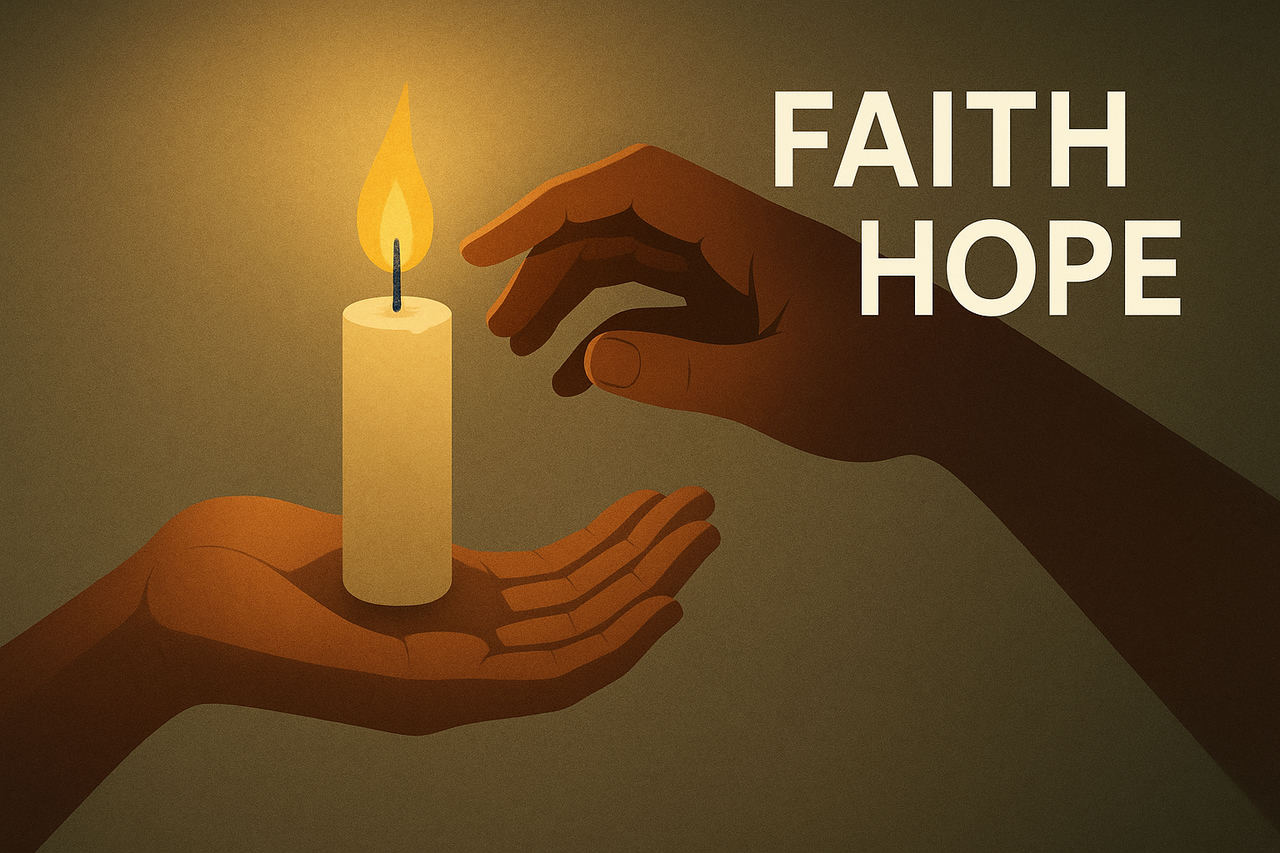
Faith & hope are not the same thing. Most people use them interchangeably, and that confusion costs them when life gets hard. If you treat them as synonyms, you lose the specific work each one does — and you end up with neither.
This article shows how faith and hope function differently in real life, what James 2 actually means when it says faith without works is dead, and how the two fit together when circumstances look impossible. No seminary required.
Key Takeaways
- When life gets hard, separate your hope from your faith deliberately: write down what you are trusting God for (faith) and what you are expecting him to do (hope) as two distinct statements, not one blurry feeling.
- Read James 2:14-26 in its full context before drawing a conclusion about what it teaches. The argument James is making is about visible evidence, not about earning salvation, and the surrounding verses change everything.
- Pick one concrete act this week that expresses what you say you believe. It does not have to be large. James's point is that faith moves, and even a small movement counts as evidence.
- If you are in a season where hope feels absent, do not conclude your faith has failed. Treat the two as separate questions: you can trust God's character even when you cannot see the outcome you are waiting for.
- Use a study tool that shows you the original Greek and Hebrew behind words like 'faith,' 'hope,' and 'substance' in Hebrews 11:1. The word choices in the original languages carry meaning that English translations compress into one word.
On this pageHope and Faith Are Not the Same ThingWhat James 2 Actually SaysHow Dead Faith Shows Up in Ordinary LifeHow Hope Keeps Faith Alive When Circumstances Say OtherwiseWhich Comes First: Hope or Faith?How to Study James 2 Deeper Without a Seminary DegreeFaith, Hope, and Love: Why Paul Ranked Them the Way He Did
Hope and Faith Are Not the Same Thing
Faith is trust in something you believe to be true right now. Hope is confident expectation about what is still coming. They point in different directions. Faith looks at God's character. Hope looks at God's promises.
Hebrews 11:1 links them directly: faith is the 'substance of things hoped for.' That word 'substance' means the underlying reality, the thing that makes hope more than a wish. Hope gives faith a target. Without hope, faith has nothing to reach toward. They need each other, but they are not the same movement.
Here is what that looks like when a diagnosis comes back bad. Hope says: God can restore this. Faith says: I trust him even if he doesn't. Those are two different statements. One is about outcome. One is about character. You can hold both at the same time, but collapsing them into one vague feeling is what makes people say their faith 'fell apart' when the outcome they hoped for didn't come.
The practical confusion runs deeper. People treat hope as wishful thinking — a kind of spiritual optimism — and faith as blind certainty. Neither holds up under real pressure. Hope grounded in a specific promise is not wishful thinking. Faith that admits doubt is not blind. Get the definitions right and you have something you can actually stand on. Start by reading Hebrews 11 slowly, one verse at a time, and notice how many of those people died without receiving the thing they hoped for.
What James 2 Actually Says
James was not arguing against Paul. He was correcting a specific problem inside his own congregation: people who claimed belief but showed zero change in how they treated the poor. That is the argument he was answering.
The Greek word James uses for 'faith' in 2:14 is pistis, the same word Paul uses in Romans. But James is describing a counterfeit version: intellectual agreement with no relational trust behind it. Knowing a fact about God is not the same as trusting God. Those are different postures.
James 2:17 says faith without works is nekra, the Greek word for a corpse. Not weak. Not sick. A corpse. A corpse never had life to begin with. James is not saying your faith needs to be stronger. He is saying what you are calling faith may not be faith at all.
James 2:19 — The Sharpest Line. 'The devils also believe, and tremble.' Demons have correct theology. They know who Jesus is. They are not saved. Intellectual agreement with true statements is not saving faith. James's point is that mere assent, with no trust and no action behind it, is the same kind of 'faith' the demons have.
The example James gives is concrete: someone is cold and hungry, you say 'be warm and filled' and walk away. That response reveals the belief was never real. It was a sentence, not a conviction. The test is not how much you feel it. The test is what you do when it costs you something.
How Dead Faith Shows Up in Ordinary Life
Dead faith uses spiritual language to avoid action. It says 'I'm trusting God for provision' while refusing to take any practical step toward the situation in front of you. It sounds humble. It is actually avoidance.
Abraham is James's first example (Genesis 22). He didn't understand why God asked what he asked. He went anyway. He loaded the wood. He walked up the mountain. He raised the knife. The action didn't earn his faith; it proved his faith was real. The belief was already there. The action made it visible.
Rahab is James's second example (2:25). She was not a theologian. She had no formal training. She hid the spies because she believed the God of Israel was real, and she acted on that belief at personal risk. Her works were the evidence, not the cause, of her faith.
Ask yourself this question honestly: in the last month, has your stated belief in God's care changed anything you actually did? Not how you felt. What you did. That is the James 2 question, and it is one you can answer about your own life right now.
How Hope Keeps Faith Alive When Circumstances Say Otherwise
Hope is not optimism. Optimism is a personality trait. Biblical hope is grounded in a specific promise from a specific God who has a track record. Those are not the same source.
Romans 5:3-5 traces the chain: suffering produces endurance, endurance produces character, character produces hope. Notice the order. Hope is downstream of hardship, not upstream of it. You do not need to feel hopeful before you suffer. The suffering is part of how hope gets built.
When faith starts to feel thin, hope is often what holds the frame together. You may not feel trust in the moment, but you can still point to the promise. That pointing is hope doing its job. It is not pretending the circumstances are different. It is saying: this promise is still true even though my circumstances are not.
Make Hope Concrete, Not General. Write down one specific verse that speaks to your situation. Not 'God is good' in the abstract, but a verse with a claim you can hold — a promise, a command, a record of what God did in a situation like yours. Read it out loud. That is hope taking a concrete form, and it gives your faith something specific to trust.
Which Comes First: Hope or Faith?
Faith comes first. Romans 15:13 calls God 'the God of hope' who fills believers 'through the power of the Holy Spirit.' The filling follows the believing. You do not manufacture hope and then decide to trust. You trust, and hope grows from that.
But hope feeds back into faith. When you rehearse what God has done — in Scripture, in your own history — hope strengthens your trust for what is ahead. They reinforce each other. It is not a straight line; it is a loop.
In a crisis, that loop can feel broken. The honest answer is that it sometimes is. Doubt is not the opposite of faith. It is faith under pressure. The disciples doubted. Thomas doubted out loud. James himself wrote to a scattered, suffering church that had every reason to give up. The letter exists because the loop was breaking for real people.
The practical question is not 'do I have enough faith.' It is: am I still turning toward God even when I don't feel it? That turning is faith in its most basic form. Hope is what makes the turning feel worth doing. Start there, even if it is small.
How to Study James 2 Deeper Without a Seminary Degree
The Greek word for 'works' in James 2 is ergon, meaning deeds or actions. That same word appears in Ephesians 2:10 for the 'good works' God prepared in advance for believers to do. Reading both passages together changes how James 2 lands. Paul and James are not contradicting each other. They are describing two sides of the same reality: saved by faith, for works.
Strong's interlinear tools let you trace a word like pistis (faith) or nekra (dead) across every place it appears in the New Testament. You see how each author uses it, which context each one is writing into, and where the meanings overlap or diverge. That context is what separates surface reading from real study.
Cross-references are essential for James 2 specifically. The chapter connects to Genesis 15 and 22 (Abraham), Joshua 2 (Rahab), Romans 3-5 (Paul on faith), and Ephesians 2:8-10 (grace and works). Pulling those together shows the whole argument. No single passage makes full sense alone.
Selah gives you the Strong's interlinear, Matthew Henry's commentary, and cross-references via the Treasury of Scripture Knowledge in one free place. Look up James 2:17, trace every connected verse, and read Henry's notes on the passage — all without switching tools or paying for anything. That is a real study session, not a quick search.
Faith, Hope, and Love: Why Paul Ranked Them the Way He Did
1 Corinthians 13:13 says the greatest of the three is love. That surprises people who expect faith to win. Paul's logic is precise: faith and hope belong to this age. Love is eternal. When we see God face to face, faith becomes sight and hope becomes possession. Love remains because love is what God is.
This does not make faith and hope less important now. It makes them the right tools for the right season. You are in the season that needs faith and hope. Use them for what they are built for.
The three are not competing. They are sequential and mutually dependent: faith trusts, hope expects, love acts. James 2 is ultimately about love. The person with real faith will love their neighbor enough to do something when that neighbor is cold and hungry. The works are love made visible.
If your faith feels thin right now, start with love. Do the concrete thing in front of you for the person in front of you. That action will not earn your salvation. But it will tell you something true about whether your faith is alive — and it may be the thing that wakes it back up.
Faith and hope are not feelings you work up. They are postures you practice, sharpened by honest reading of Scripture and tested by what you actually do. The Bible gives you both the map and the examples. Your job is to keep turning toward the God they point to.
If you want to go deeper on any passage mentioned here, Selah has the interlinear, commentary, character profiles for Abraham and Rahab, and the cross-reference tools to follow every thread — all free, all in one place.
Frequently asked questions
Is hope the same as faith in the Bible, or do they mean different things?
They are related but distinct. Faith is present-tense trust in who God is right now. Hope is forward-looking confidence in what God has promised to do. Hebrews 11:1 shows the connection: faith is the 'substance' of things hoped for, meaning faith gives hope a solid foundation rather than leaving it as a wish.
Does James 2 contradict Paul's teaching that we are saved by faith alone?
No. Paul and James are answering different questions. Paul addresses how a person is justified before God (by faith, not by keeping the law). James addresses how genuine faith is recognized by other people (through visible action). James is not adding works as a second requirement for salvation; he is saying that real faith always produces evidence you can see.
What does it mean practically that faith without works is dead?
It means faith that never changes your behavior is not functioning faith at all. James uses Abraham and Rahab as examples: both believed, and both acted on that belief in a moment that cost them something. The works did not create the faith; they proved it was alive. A practical test: if your stated belief has produced zero change in how you live, James says that belief deserves a second look.
Can you have genuine faith during seasons when you feel no hope at all?
Yes. Faith and hope are not the same emotional state, so the absence of one does not automatically cancel the other. Psalms like 22 and 88 show believers crying out with no felt sense of hope while still directing their words to God, which is itself an act of trust. Feeling hopeless is a real experience; it is not the same as losing faith.
What is the difference between biblical hope and ordinary wishful thinking?
Wishful thinking has no anchor. Biblical hope is grounded in specific promises God has already made and a track record of keeping them. The Greek word used in the New Testament for hope (elpis) carries the sense of confident expectation, not mere desire. The difference is the object: wishful thinking points at an outcome you want; biblical hope points at a God whose character guarantees the outcome.
Which comes first in the Christian life: faith or hope?
Faith comes first in the logical order. You trust God's character before you can confidently expect his promises. But in practice they develop together: as faith grows through experience, hope becomes more specific and more stable. Neither one is a one-time event; both deepen over time as you accumulate evidence of God's faithfulness.
Study Faith and Hope Word by WordSelah gives you the full Bible text, Strong's interlinear data for every Hebrew and Greek word, character profiles for figures like Abraham and Rahab, and Matthew Henry's commentary — all free, no account required.Start studying free →
Comments
Be the first to comment.