Five People in the Bible Who Modeled Extraordinary Hope
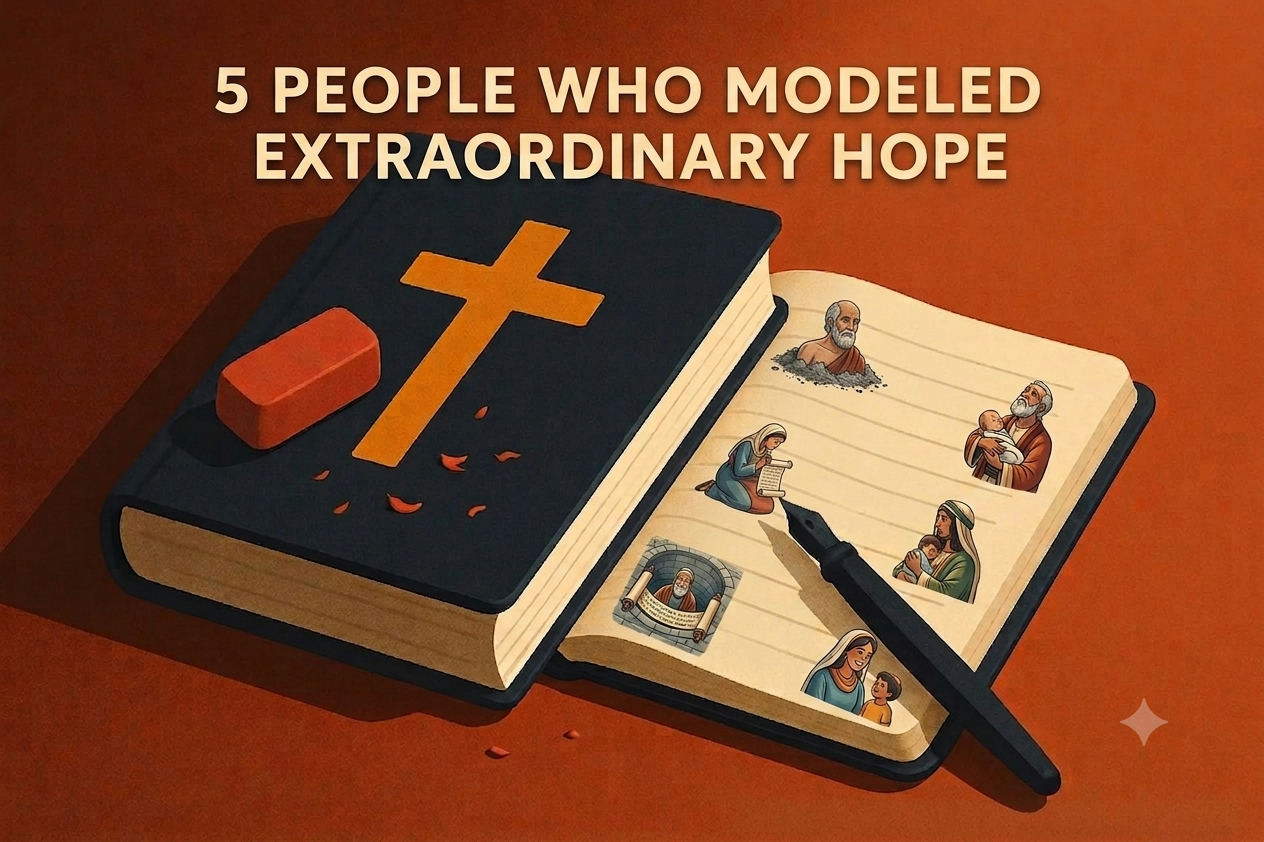
Five People in the Bible Who Modeled Extraordinary Hope
Faith & hope are not decorations on a Christian life. They are the engine. But most of us learned them as definitions, not as practices. Hebrews 11:1 gives the classic line: faith is the substance of things hoped for, the evidence of things not seen. That is true. It is also abstract until you watch a real person live it out under real pressure.
The biblical figures who actually modeled faith and hope did not do it in calm moments. They did it while waiting decades, grieving losses, hiding in caves, and sitting in prison cells. Studying what they did, not just what they believed, is where the definitions finally come alive.
Key Takeaways
- Pick one biblical figure from this article and read their full story in one sitting. Notice the specific moment their faith moved from belief to action, because that gap is where your own faith gets built.
- When you feel like hope is gone, name what you are actually waiting for. Abraham waited for a son. Ruth waited for provision. Paul waited for release. Naming the specific thing you are trusting God for is the first step from abstract hope to biblical hope.
- Use the character profiles on Selah to trace a biblical figure across every verse they appear in, not just the famous ones. The lesser-known moments are usually where the real faith shows up.
- The next time you read a passage about hope or faith, look up the Hebrew or Greek word behind it. Even a five-minute word study changes how the verse lands. Selah's Strong's interlinear reader makes that possible without buying any software.
- If a particular biblical figure's story is speaking to you right now, follow the cross-references tied to their key verses. One verse rarely tells the whole story.
On this pageWhat Faith and Hope Actually Mean When Life Gets HardAbraham: Hoping for a Son He Could Not SeeJob: Holding On to Hope After Losing EverythingRuth: Choosing Loyalty When the Easier Path Was Right ThereDavid: Writing Songs of Hope From a CavePaul: Finding Hope Inside a Prison CellHow to Study These Stories Deeper on Your OwnThe One Thread That Connects All Five Stories
What Faith and Hope Actually Mean When Life Gets Hard
Faith and hope are related but not the same. Faith is trust in who God is right now. Hope is confident expectation of what God will do next. You can feel hopeful without acting on it. Biblical faith, though, always moves the person forward. It shows up as a decision, a step, a refusal to quit.
The reason studying real people matters more than memorizing Hebrews 11:1 is simple: definitions do not tell you what to do at 2 a.m. when the situation looks impossible. Watching Abraham pack his household, or Ruth walk into a foreign field alone, or Paul write about joy from a prison cell, that tells you something you can actually use.
For a careful look at how the two words differ theologically, GotQuestions has a solid breakdown. But the real education is in the stories. Start there.
Abraham: Hoping for a Son He Could Not See
Abraham was 75 years old when God promised him a son. He waited 25 years before Isaac was born. That is not a short season of patience. That is a quarter century of waking up every morning and choosing to believe something that looked biologically impossible.
Romans 4:18 describes it plainly: Abraham believed 'in hope against hope.' The natural evidence was completely against him. His body, as Paul puts it, was 'as good as dead.' Sarah was past childbearing age. Every reasonable calculation said no.
But Abraham did not sit still. He packed up his entire household and left his homeland on the strength of a promise. He built altars throughout the wait, which in the ancient world was a public act of worship and commitment. His faith and hope were not feelings that came and went. They were decisions he made repeatedly, over decades, before he saw a single result.
The 25-year pattern worth noticing. Abraham's story shows that biblical hope is not optimism. Optimism says things will probably work out. Hope, in the biblical sense, is a settled expectation rooted in God's character, not in the odds. The practical question Abraham's life raises: what would you do differently today if you actually believed the promise was coming?
If you want to trace Abraham's full story, Selah has a complete character profile including his life timeline, every verse he appears in, and family context. Open it alongside Genesis 12 and Romans 4 and the arc becomes much clearer.
Job: Holding On to Hope After Losing Everything
Job lost his children, his wealth, and his health in a single sequence of disasters. His friends told him to confess hidden sin or give up. Job refused both. He argued with God, wept openly, and demanded answers. Scripture does not treat any of that as a failure of faith.
The most striking moment comes in Job 19:25, spoken at his absolute lowest point: 'I know that my Redeemer lives.' That is not a calm confession from a comfortable man. That is a declaration made from ash heaps and open sores, surrounded by people telling him God had abandoned him.
Job's story is one of the clearest examples of hope in the Bible from a biblical figure under total collapse. What it shows is that honest grief and stubborn hope can exist in the same person at the same time. You do not have to pretend to feel fine in order to have faith. Job did not. God commended him anyway.
Read Job 19 in the interlinear reader on Selah and look up the Hebrew behind 'Redeemer' (go'el). It carries the weight of a kinsman-redeemer, someone with a legal obligation to rescue you. That single word changes how the verse lands.
Ruth: Choosing Loyalty When the Easier Path Was Right There
Ruth had a clear exit. Naomi told her twice to go back to her own people and her own gods. The practical case for leaving was strong: Ruth was young, she had no children, and returning home gave her a real chance at remarriage and security. She stayed anyway.
Her words in Ruth 1:16 are famous, but they are easy to read as sentiment. They are actually a statement of faith. Ruth was committing herself to a God she had only recently come to know, based entirely on what she had seen that God do for Naomi's family. No direct promise had been spoken to her. No covenant had been made with her specifically. She acted before she had any guarantee.
This is one of the clearest examples of hope in the Bible from a biblical figure who had no prior covenant relationship with God. Ruth's hope was not based on personal history with God. It was based on observed character. She gleaned fields, she worked, she trusted the outcome to someone else entirely.
The practical angle here is direct: you do not need a dramatic personal encounter to act on faith. Ruth's example suggests that watching what God does in other people's lives is a legitimate basis for trust. Read her profile on Selah alongside the book of Ruth to see how the timeline of her decisions maps to the text.
David: Writing Songs of Hope From a Cave
Psalm 57 and Psalm 142 were both written while David was hiding from Saul in a cave, fearing for his life. The superscriptions in the text say so directly. These are not poems written in retrospect from a palace. They are raw, in-the-moment documents.
David's pattern across the psalms is consistent and learnable. He opens with the raw problem, names it without softening it, and then pivots to what he knows about God's character. He does not wait until the crisis is over to praise. He praises in the middle of it. That pivot is a specific, repeatable practice, not a personality quirk.
Psalm 27:13 captures the posture well: 'I believe that I will see the goodness of the Lord in the land of the living.' That is a declaration about this life, not just the afterlife. David was not consoling himself with heaven. He was asserting that God would act here, now, in real time.
The practical next step from David's example: pick one psalm written in crisis, Psalm 57 or Psalm 22 are good starting points, and read it in three parts: the complaint, the pivot, the declaration. Then try writing your own version of that structure for whatever you are facing right now.
Paul: Finding Hope Inside a Prison Cell
Paul wrote Philippians from prison. The word 'joy' appears 16 times across four chapters. That is not an accident of vocabulary. It is a sustained argument that hope is not circumstantial.
In Philippians 4:11, Paul says explicitly that he had 'learned' contentment. That word matters. Contentment was not his natural state or his personality type. It was a skill he developed through repeated experience of both abundance and need. Hope, for Paul, was something you practice and build, not something that either shows up or does not.
Romans 5:3-5 traces the chain even more precisely. Suffering produces perseverance. Perseverance produces character. Character produces hope. That is a specific sequence, not a vague promise that hard times make you stronger. Paul is saying that hope is the output of a process you go through, and that the process starts with suffering, not with comfort.
Paul's life is the most documented example of sustained faith and hope under repeated pressure in the entire New Testament. He was shipwrecked, beaten, imprisoned, and rejected by communities he had planted. The relationship between faith and hope that Paul describes in his letters is not theoretical. It was field-tested across decades. Start with Romans 5 and Philippians 4 side by side.
How to Study These Stories Deeper on Your Own
Each of these five figures has a full character profile on Selah, including life timelines, every verse they appear in, and family context. You do not need a commentary shelf or a seminary degree to go deep. You need the right tools in one place.
The Selah Bible reader includes Strong's interlinear data, which maps every word in the text back to its original Hebrew or Greek. The Greek word for hope is elpis. The Hebrew is tiqvah. Both carry a sense of expectant waiting, not passive wishing. Looking up those words in context changes how you read every verse that uses them.
Matthew Henry's Complete Commentary is also available free on the platform, queryable by chapter. His notes on Job 19, Ruth 1, and Romans 5 add centuries of interpretive depth without requiring you to track down a physical volume.
A practical study sequence. Pick one figure from this article. Open their character profile on Selah. Read every verse listed in their profile that touches on faith or waiting. Then open the same passage in the interlinear reader and look up the original word for hope. Finally, read Matthew Henry's note on that chapter. That sequence takes about 30 minutes and goes further than most devotional books.
The One Thread That Connects All Five Stories
None of these five people had easy circumstances. The common thread is not that God removed the difficulty. It is that each person kept acting on what they believed before the outcome was clear. Abraham moved before Isaac arrived. Ruth committed before Boaz appeared. David praised before Saul was defeated. Job declared his Redeemer before God answered from the whirlwind. Paul wrote about joy before he was released.
Faith and hope in the Bible are almost always shown in motion, not in stillness. The difference between these figures and people who gave up is not talent or personality. It is that they had a specific object for their hope: God's character and God's promises, not their own ability to manage the situation.
That is the question worth sitting with: what are you actually trusting when you say you have hope? If the answer is your own plan, your own resilience, or a favorable outcome, the biblical figures above would gently push back. Their hope was anchored outside themselves. That is what made it hold.
Frequently asked questions
What is the difference between faith and hope in the Bible?
Faith is present-tense trust in who God is right now. Hope is forward-facing confidence in what God has promised to do. Hebrews 11:1 links them tightly: faith is described as the substance of things hoped for, meaning hope gives faith its direction. You can read a careful theological breakdown at GotQuestions.
Can you have genuine hope without faith, or do they always go together?
In everyday life, people feel optimistic without any faith at all. But biblical hope is different: it is grounded in God's character and his specific promises, which means it requires faith as its foundation. Without trust in the one who made the promise, hope becomes wishful thinking rather than confident expectation. The two are distinct but inseparable in Scripture.
What does the Bible say about hope when you feel like giving up?
Romans 5:3-5 is the clearest passage: suffering produces perseverance, perseverance produces character, and character produces hope. That sequence matters because it means hope is not the starting point, it is what gets forged through the hard part. Lamentations 3:21-23 is another anchor: Jeremiah chose to call something to mind in the middle of grief, and that choice shifted his posture from despair to expectation.
Are faith, hope, and love called the theological virtues?
Yes. Theologians, particularly in the Catholic and Anglican traditions, call faith, hope, and love the three theological virtues because they are directed toward God himself rather than toward human flourishing in general. Paul names all three in 1 Corinthians 13:13, where he says the greatest of the three is love. The label 'theological' distinguishes them from the cardinal virtues like prudence and courage, which can be practiced without reference to God.
Which Bible verse best captures the relationship between faith and hope?
Hebrews 11:1 is the most direct: 'Faith is the substance of things hoped for, the evidence of things not seen.' It shows that faith and hope are not parallel but interlocking: hope sets the object, faith supplies the grip. For a verse-by-verse look at how the two themes run through Scripture together, BibleRepository has a useful collection.
How do I build hope when my circumstances have not changed?
Start with what has already been proven true. Every biblical figure who modeled hope did so by remembering past faithfulness before trusting future promises. David rehearsed his victories over the lion and the bear before he faced Goliath. That pattern is practical: write down one specific time God came through for you, then read a promise tied to your current situation. Hope grows by rehearsal, not by waiting for feelings to shift.
Read the People Behind the PromisesSelah's character profiles trace each biblical figure across every verse they appear in, complete with family trees, life timelines, and the places they traveled. It's free, no account required.Explore biblical characters →
Comments
Be the first to comment.