Free Sermon Preparation Tools That Cover Your Whole Prep Workflow
Free Sermon Preparation Tools That Cover Your Whole Prep Workflow
Most lists of sermon preparation tools free you from paying for software but leave you paying in time. You end up with fourteen browser tabs, three logins, and a half-formed thought you lost somewhere between the Greek lexicon and the commentary site. That is the real problem, and this article solves it by pointing you to one platform that handles the whole workflow, plus one optional add-on for the one thing it does not cover.
The short answer: Selah for deep Bible study, and Sermon Mate for organizing your outline. Most weeks, that is all you need. Everything below explains why and shows you exactly how to run a prep session from scratch.
Key Takeaways
- Open Selah first, before any other tab, and read your passage in the interlinear reader to see every Hebrew or Greek word mapped directly to the English text — no prior language training required.
- Use Selah's character and place profiles to build your sermon's context before you write a single outline point: look up every person and location named in your passage and read their full profile.
- Run your passage through Matthew Henry's Commentary on Selah, then check the cross-references via Treasury of Scripture Knowledge before you decide on your main point — this order prevents you from building a sermon on a misread text.
- Take your confirmed main point and three supporting ideas into Sermon Mate to build your outline, keeping Selah open in a second tab for any word or reference you still need to verify.
- If you are planning a sermon series, check Selah's nine reading plans to find a structure that already maps the arc of the books or themes you want to preach through.
On this pageWhy Most Free Tool Lists Leave You Juggling Five WebsitesWhat a Complete Free Sermon Prep Platform Actually Needs to DoSelah: The One Free Platform That Connects All Four Prep StagesHow to Run a Full Sermon Prep Session Using SelahWhen You Actually Need a Second Tool (and Which One)Sermon Mate: The Fastest Starting Point If You Have One HourThe Free Sermon Prep Stack, Simplified
Why Most Free Tool Lists Leave You Juggling Five Websites
Sites like Sermons of Light and Reach Right Studios list anywhere from 14 to 23 separate tools. One for Greek. One for commentary. One for illustrations. One for outlines. Each is fine on its own. Together, they create a context-switching problem that quietly eats your prep time.
A pastor preparing a 30-minute sermon typically spends 10 to 20 hours in research and drafting. The time lost is rarely in finding the tools. It is in moving between them. You are mid-thought on Galatians 2, you switch tabs to check a Greek word, you land on a commentary, you follow a cross-reference, and twenty minutes later you have forgotten what you were trying to say. Fragmented tools make this worse, not better.
The fix is not more tools. It is fewer tools that each do more. One platform that connects the text, the original languages, the characters, the cross-references, and your sermon notes changes the whole workflow. Start by asking: does this tool cover at least two stages of my prep, or does it hand me off to something else?

What a Complete Free Sermon Prep Platform Actually Needs to Do
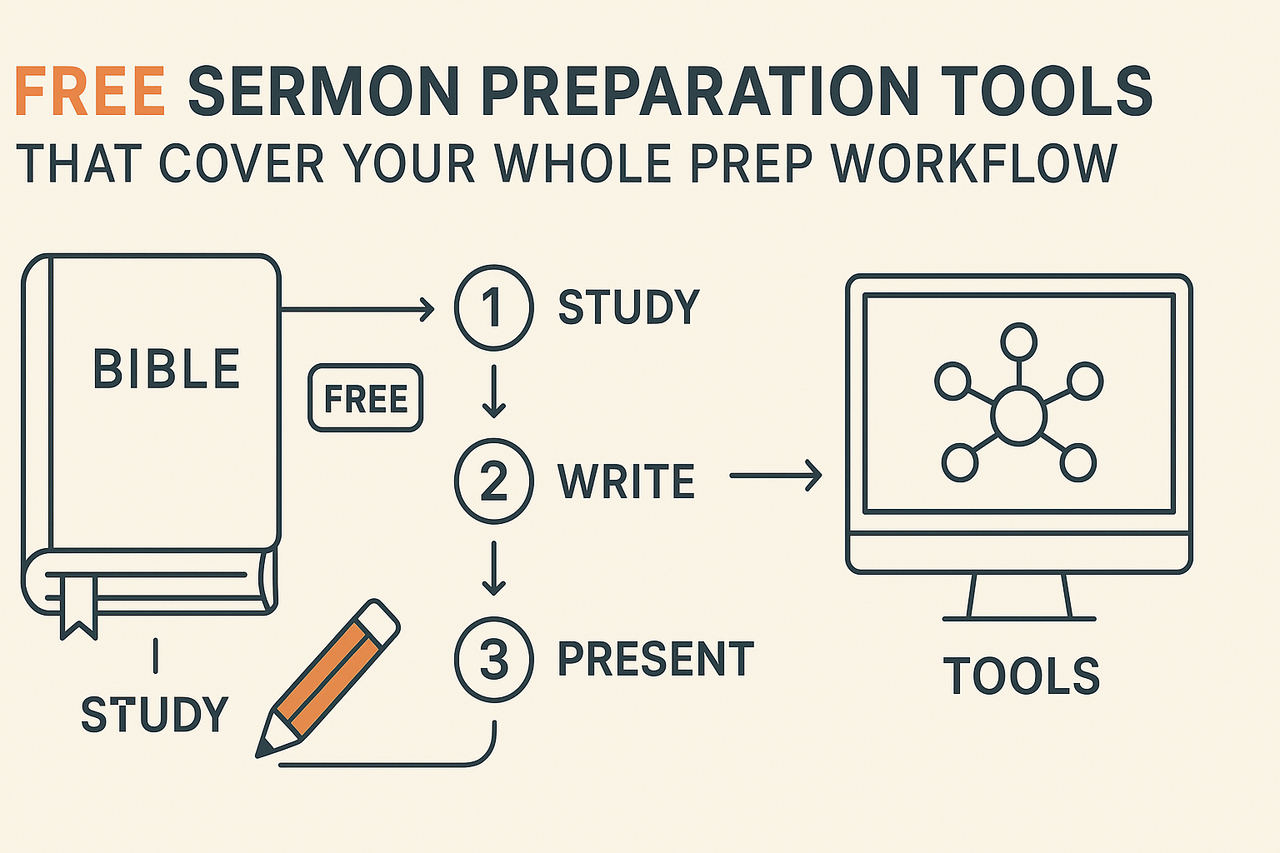
Sermon prep has four stages: study the text deeply, understand the people and context in the passage, find supporting cross-references and commentary, then organize your findings into a structure you can preach. A tool earns its place only if it covers at least two of those stages without sending you elsewhere.
Original-language access is not optional for expository preaching. Knowing that the Greek word translated "peace" in Philippians 4:7 is eirene, which carries the sense of wholeness and binding together, gives you a sermon point you cannot get from the English alone. Most free tools either hide this behind a paywall or bury it three clicks deep.
Character and place context matters more than most prep guides admit. Knowing who Barnabas was, where Antioch sat on a map, and every verse that mentions him changes how you preach Acts 11. That background is not decoration. It is the difference between a sermon that feels alive and one that feels like a lecture.
Commentary should be queryable by chapter, not just searchable by keyword. Matthew Henry's verse-by-verse commentary is public domain and genuinely useful, but only when you can pull it up for the exact passage you are preaching, not when you have to hunt through a search engine to find the right section. Pick a platform that surfaces it by reference.
Selah: The One Free Platform That Connects All Four Prep Stages
Selah is a free Bible study platform that combines the full Scripture reader, a Strong's interlinear, 272+ biblical character profiles, 111+ place profiles, Matthew Henry's Complete Commentary, and cross-references via the Treasury of Scripture Knowledge, all in one place with no paywall and no account required to start reading.
Study the Text With Original Languages Built In
The interlinear reader links every word in a passage to its Hebrew or Greek root. Tap a word, and you see its Strong's concordance number, its range of meaning, and every other verse in Scripture where that same word appears. No separate app. No subscription. This is the layer where most free tools either stop or charge you.
Understand Every Person and Place in Your Passage
Character profiles on Selah include family trees, life timelines, places visited, and every verse the person appears in. If you are preaching on Peter, you can read his full arc in one profile rather than hunting across a concordance. The 111+ place profiles include GPS coordinates, modern names, and every Scripture event tied to that location. Four minutes with a character profile typically surfaces three or four concrete details you can use in the pulpit.
Cross-References and Commentary Without Leaving the Page
Matthew Henry's commentary is queryable by chapter inside Selah. Open it for the passage you are preaching, read the opening paragraph, and you usually get a one-sentence summary of the passage's main point. That is often the clearest statement of your sermon's big idea. Treasury of Scripture Knowledge cross-references surface related passages instantly, so you can trace a theme across the whole Bible without opening a second site.
How to Run a Full Sermon Prep Session Using Selah
This is a repeatable workflow. Run it the same way every week and the steps become fast.
- Open the passage in the Bible reader. Read it in two or three translations using the translation comparison feature. Notice where the English differs between versions. Those differences usually point to a word worth studying.
- Switch to the interlinear view for the key verse. Find the two or three words that carry the theological weight of the passage. Note the Strong's number and the range of meaning. Write one sentence about what the original word adds to your understanding.
- Pull up the character profile for the main figure in the passage. Read the life timeline and the places visited. This takes about four minutes and gives you concrete biographical detail you can use as illustration.
- Open Matthew Henry's commentary for that chapter. Read his opening paragraph. Use his summary as a test: does your big idea match what the passage is actually about?
- Drop your notes, outline structure, and key verses into Sermon Mate. You now have a draft skeleton without opening a second website.
First session: budget 90 minutes. A pastor who knows the passage well can run this full workflow in 90 minutes. If you are new to the text, add 30 minutes for the character and place research. The workflow stays the same either way. Do not skip the interlinear step, even if you have no Greek or Hebrew background. The Strong's definitions are written for non-scholars.
When You Actually Need a Second Tool (and Which One)
Selah covers study, context, commentary, and sermon organization. The one gap is illustrations drawn from outside Scripture: contemporary stories, cultural references, statistics. If your preaching style relies heavily on those, you will need one more resource.
SermonCentral offers a large searchable illustration library on its free tier. Use it after your text study is done, not before. An illustration should serve the passage. If you find the illustration first, you will unconsciously bend the passage to fit it.
If you preach from a manuscript and want a distraction-free writing environment, Google Docs works fine. Do not buy software for this. A plain text editor and a clear outline are all the writing environment you need.
The rule is simple: add a second tool only when Selah cannot do the specific job. Most weeks, it can. Check there first.
Sermon Mate: The Fastest Starting Point If You Have One Hour
If you are preparing your first sermon or returning after a long break, start with Sermon Mate rather than trying to configure a multi-tool stack. It is designed for pastors who need to move from a passage to a preachable outline quickly, without getting lost in the research layer.
The shortest path from blank page to Sunday looks like this: pick your passage, run through Selah's interlinear and character profiles for word study and context, then bring your notes into Sermon Mate to shape the outline. That sequence keeps the study and the structure connected without requiring you to manage five separate systems.
Start with Sermon Mate today. Add Selah's deeper study tools as your prep time and confidence grow. The link below takes you directly there.
Start Your Sermon Prep in One PlaceSermon Mate is built for pastors who need to go from a passage to a preachable outline fast. Free to use, no complicated setup. Open it, pick your text, and start building your sermon today.Open Sermon Mate →
The Free Sermon Prep Stack, Simplified
Here is the full stack. Three tools maximum. Most weeks, two.
- Selah for text study, Strong's interlinear, character and place context, Matthew Henry's commentary, and Treasury of Scripture Knowledge cross-references. Free, no paywall.
- Sermon Mate for outline structure and sermon organization. Built specifically for pastors. Start here if you are short on time.
- SermonCentral free tier for outside-Scripture illustrations, only when your passage calls for them.
What you do not need: a paid Bible software subscription, a separate Greek lexicon app, a standalone commentary site, or a paid outline generator. Every one of those jobs is covered free by this stack.
The goal is not to collect tools. It is to preach a faithful, well-studied sermon every week without spending money or losing hours to tab-switching. Pick the passage, open Selah, follow the five steps above, and bring your notes into Sermon Mate. That is the whole system.
Frequently asked questions
Is Selah's interlinear reader actually free, or does it lock features after a few uses?
The interlinear reader on Selah is completely free with no usage cap and no paywall. Every word in the Bible is mapped to its Hebrew or Greek concordance number, and you can access Strong's definitions for any word without creating an account.
What does Sermon Mate do that a plain notes app cannot?
Sermon Mate is built specifically for sermon structure, so it organizes your content around points, sub-points, Scripture references, and illustrations rather than just freeform text. A notes app holds whatever you type; Sermon Mate holds a sermon. That distinction matters when you are 90 minutes into prep and need to see the shape of what you are building.
Can I use these tools if I have no background in Hebrew or Greek?
Yes. Selah's interlinear reader shows the original word alongside the English translation, and clicking any word pulls up a plain-English definition from the Strong's concordance. You do not need to know the alphabet. You just need to know which English word you want to investigate.
How long does a realistic sermon prep session take using this two-tool approach?
Most pastors report spending 10 to 20 hours per sermon across a full week, but a focused single session using one platform typically runs two to four hours for research and a first draft outline. Cutting the tab-switching is where you recover the most time, not by reading less.
Does Selah include reading plans that could structure a whole sermon series?
Yes. Selah offers nine structured reading plans, including options that move through the Gospels in 40 days or the whole Bible in 90 days. A pastor planning a series on a single book or era can use those plans to set the pace and sequence of the series before writing a single message.
What should a first-time preacher do in the first 30 minutes of sermon prep?
Read the passage three times in different translations, then open the interlinear reader and look up every word that carries the weight of the text. Write down what surprises you. That list of surprises is usually where your sermon lives.
Build Your Next Sermon with Sermon MateSermon Mate gives you a focused space to turn your research into a real outline, so your prep time ends with a sermon, not a pile of notes. Pair it with the free study tools on Selah and you have everything you need from first read to final draft.Try Sermon Mate Free →
Comments
Be the first to comment.