How to Forgive Someone Who Has Never Said Sorry
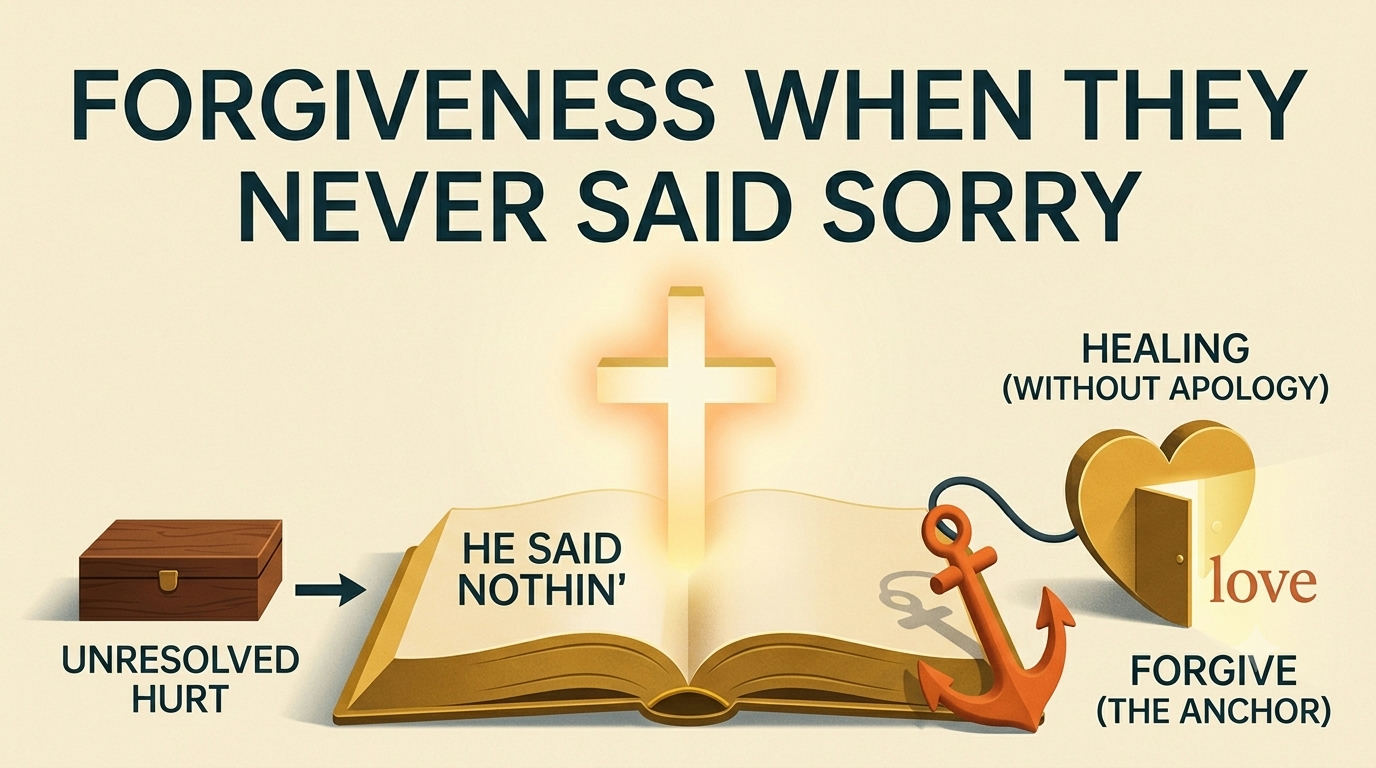
How to Forgive Someone Who Has Never Said Sorry
Grace and forgiveness are not the same thing, and confusing them is exactly why so many Christians stay stuck. You know you are supposed to forgive. You believe in grace. But the person who hurt you has never said sorry, and the anger is still there. That is not a faith failure. It is a real problem that deserves a real answer.
The Bible does not wait for the offender to cooperate before it calls you to act. Jesus forgave people mid-sin. Stephen prayed for his killers while the rocks were still flying. The biblical model for grace and forgiveness is one-sided by design, and understanding why changes everything about how you approach the person who owes you an apology they will never give.
Key Takeaways
- Write the name of the person who hurt you on a piece of paper, then write the specific debt you are releasing — what they owe you that you will never collect. This is not symbolic theater; it is the transaction aphiemi describes.
- The next time the anger comes back, treat it as a signal to pray, not as proof that you failed. Forgiveness is a decision you make once and then defend repeatedly against your own memory.
- Set whatever boundary protects you from ongoing harm, and do not let anyone tell you that boundary contradicts your forgiveness. The two are separate acts that can coexist without contradiction.
- Read the accounts of Joseph (Genesis 37-50) and Stephen (Acts 7) in full, not just the highlight verses. Watching how each man handled betrayal without an apology gives the process a shape you can actually follow.
- If you are studying the biblical language of forgiveness, look up aphiemi and charizomai in a Strong's interlinear. Selah maps every New Testament word to its Greek root for free, so you can see exactly what the text is asking of you.
On this pageGrace and Forgiveness Are Not the Same ThingWhat the Bible Actually Requires When There Is No ApologyHow to Actually Forgive Someone Who Never ApologizedForgiving Without an Apology Is Not the Same as Excusing the WrongWhen Forgiveness Feels Impossible: What to Do With the AngerThe Grace You Extend Reflects the Grace You Have Received
Grace and Forgiveness Are Not the Same Thing
Grace is unearned favor given freely. Forgiveness is the specific act of releasing a debt someone owes you. They overlap, but they are not identical, and the difference matters the moment someone wrongs you and walks away.
Grace describes God's posture toward sinners before they repent. He does not wait for you to clean yourself up before he moves toward you. Forgiveness describes what happens when the debt itself is canceled. You can extend grace to someone, treating them with basic dignity and goodwill, while the forgiveness process is still underway.
The Greek word translated as forgiveness in the New Testament is aphiemi. It literally means 'to send away' or 'to release.' That is a transaction, not a feeling. You are not being asked to feel okay about what happened. You are being asked to release the claim you hold against the person who hurt you. That is a choice you make with your will, not a mood that arrives on its own.
Most articles on this topic skip that distinction. The result is Christians who think forgiveness means pretending the wrong never happened, or waiting until the anger goes away. Neither is what the Bible asks. Name the debt clearly. Then release it. Those are two separate steps, and both require honesty.
Aphiemi: release, not erasure. The Greek word aphiemi appears over 140 times in the New Testament. In legal contexts it meant releasing a prisoner or canceling a financial obligation. When Jesus uses it for forgiveness, the picture is a creditor tearing up a debt note, not a victim pretending no harm was done.
Start here: look up one passage that uses the word 'forgive' and ask what debt is being released. That single question reframes the whole conversation.
What the Bible Actually Requires When There Is No Apology
The Bible does not make your forgiveness conditional on the other person's remorse. It makes it conditional on your own experience of being forgiven.
Jesus said from the cross, 'Father, forgive them, for they do not know what they are doing' (Luke 23:34). The soldiers were still mid-act. No one had asked for mercy. Stephen, the first Christian martyr, echoed the same prayer while he was being stoned: 'Lord, do not hold this sin against them' (Acts 7:60). Both men forgave without waiting for a single word of regret from the crowd.
Ephesians 4:32 sets the standard plainly: forgive 'as God in Christ forgave you.' God forgave you before you were born, before you sinned, before you asked. That is the model on the table. The trigger for your forgiveness is not the other person's apology. It is the size of what was already released toward you.
One distinction the Bible draws carefully is the difference between forgiveness and reconciliation. Forgiveness is one-sided. You can do it alone, today, without the other person in the room. Reconciliation takes two people, requires trust, and may not be possible or safe. Treating them as the same thing is one of the most common reasons people delay forgiving. They think forgiving means resuming the relationship. It does not.
Read Luke 23:34 in a Bible reader that shows cross-references. Notice how many other passages it connects to. That web of verses is where the theology of unilateral forgiveness becomes visible.
How to Actually Forgive Someone Who Never Apologized
Name the debt clearly before you release it
You cannot release a debt you have not named. Write down specifically what was done and what it cost you: emotionally, relationally, practically. This is not wallowing. It is precision. Vague hurt produces vague forgiveness that does not hold.
Pray the release out loud, even when it feels hollow
Forgiveness is an act of the will before it is a feeling. Pray something concrete: 'I release [name] from what they owe me. I hand this debt to God.' Say it out loud. Repeat it on the days the anger comes back, because it will come back. The repetition is not evidence that the first prayer failed. It is evidence that the wound was real and the will is still choosing.
Expect the feeling to lag behind the decision by days, weeks, or longer. That lag is normal. The decision is the forgiveness. The feeling is the fruit that follows, on its own schedule.
Decide what reconciliation looks like separately from forgiveness
You can forgive someone and still choose not to resume the relationship, especially where there is ongoing harm. Forgiveness protects your soul. Boundaries protect your safety. These are not in conflict. Forgiving someone does not obligate you to hand them another opportunity to repeat the offense.
One of the clearest case studies in Scripture is Joseph, whose story runs from Genesis 37 to 50. He forgave his brothers years before they apologized, and the text does not hide the emotional cost. He wept. He tested them. He waited. The forgiveness was real, and so was the process. Study his story using the character profiles on Selah to trace every passage where Joseph appears alongside the people who wronged him.
Forgiving Without an Apology Is Not the Same as Excusing the Wrong
Forgiveness is not saying 'it was fine.' It is saying 'it was wrong, and I am choosing not to hold it against you.' The wrongness of the act is not erased. The debt is.
The theologian Dietrich Bonhoeffer called grace that costs nothing and changes nothing 'cheap grace.' True forgiveness costs you something real: the right to collect. You are giving up your claim. That is not a small thing, and the Bible does not pretend it is.
You are not required to tell the person you have forgiven them, particularly if contact would cause further harm. The forgiveness happens between you and God first. It is an internal transaction before it is ever an external conversation.
Minimizing the wrong actually short-circuits the process. If you tell yourself 'it wasn't that bad,' there is nothing to release. Naming the sin accurately, calling it what it was, is part of what makes the release real. Precision in naming the wrong is an act of honesty, not bitterness.
Name it before you release it. Before you pray for release, write one sentence that names the specific wrong and one sentence that names what it cost you. Keep it factual, not emotional. That two-sentence exercise gives your prayer something concrete to hand to God rather than a fog of general hurt.
When Forgiveness Feels Impossible: What to Do With the Anger
Anger after a real wrong is not a sin. Psalm 4:4 says 'be angry and do not sin.' The problem is not the anger itself. It is what you do with it over time.
Bring the anger to God directly and without cleaning it up first. Psalm 55 and Psalm 109 are raw, unfiltered complaints to God. The writers did not smooth their language before praying. They told God exactly what they wanted done to their enemies. That honesty is not a lack of faith. It is what faith looks like when it is under real pressure.
If the anger keeps returning after you have prayed the release, that is not evidence that you have not forgiven. It is evidence that the wound was deep. Forgiveness is a decision you may need to renew more than once. Each renewal is not starting over. It is the same decision holding under pressure.
If you are genuinely stuck, a pastor or counselor who works from Scripture can move you forward faster than working alone. For passage-level study, the Bible commentary and study tools at Selah let you search Matthew Henry's complete commentary on key forgiveness passages for free, without a subscription or paywall.
The Grace You Extend Reflects the Grace You Have Received
Matthew 18:21-35 is the sharpest passage on this. A man forgiven a debt worth millions refuses to forgive a debt worth a few dollars. Jesus does not call him mean. He calls him someone who failed to understand what happened to him.
The logic of Christian forgiveness is not 'be a nice person.' It is this: you have been forgiven an unpayable debt, so releasing a smaller one is the only coherent response. That is not guilt-tripping. It is reorientation. When forgiveness feels impossible, the place to start is not the other person's wrong. It is the size of what God released toward you.
Romans 5:8 puts the scale plainly: 'while we were still sinners, Christ died for us.' Colossians 2:13-14 adds the image of a debt record nailed to the cross and canceled. These are not abstract theological claims. They are the ground under every act of forgiveness you are ever asked to perform.
Trace how those two passages connect to others using a Bible reader with cross-references. The forgiveness and grace topic pages on Biblehub are one place to start that kind of verse-by-verse tracing.
Forgiveness without an apology is hard because it is supposed to be. It costs you the right to collect. But the Bible's case is that you are not giving up something you were ever meant to keep. You are releasing a debt into hands that are better equipped to handle it than yours. That is not weakness. That is the most deliberate act of faith in the Christian life.
Start with one name. Write the debt. Pray the release. Then study the story of someone in Scripture who did it before you. The text will meet you there.
Frequently asked questions
Does forgiving someone mean I have to trust them again?
No. Forgiveness releases the debt; trust is rebuilt by consistent behavior over time, and it is not owed automatically. You can fully forgive someone and still decline to put yourself back in a position where they can hurt you the same way again. The two decisions operate on different timelines.
What is the biblical difference between forgiveness, grace, and mercy?
Grace is unearned favor extended before any repentance or change. Mercy is withholding a punishment someone deserves. Forgiveness is the specific cancellation of a debt owed to you personally. All three appear together in how God deals with people, but they are distinct acts, not interchangeable words.
What if I forgive someone and the anger comes back? Does that mean I failed?
It means you are human, not that the forgiveness was invalid. The decision to forgive is made once; the emotions catch up slowly and unevenly. Each time the anger resurfaces, you return to the decision you already made rather than starting over. That is maintenance, not failure.
Can I forgive someone in my heart without ever telling them?
Yes, and in many cases that is the wiser path. Biblical forgiveness is primarily a transaction between you and God, not a conversation you are required to have with the offender. Telling someone you forgive them can be healing, but it can also reopen harm if the person is unsafe or unrepentant. The internal release is what Scripture requires; the conversation is situational.
How do I forgive someone who keeps hurting me and shows no remorse?
You forgive the past offense as a settled decision, and then you address the ongoing behavior with a boundary, not more tolerance. Forgiving someone does not obligate you to keep absorbing new wounds. Luke 17:3 actually instructs believers to rebuke the offender, which means confronting the pattern is part of the biblical process, not a contradiction of forgiveness.
Is it wrong to grieve what was done to me even after I forgive?
Grief and forgiveness are not opposites. Releasing a debt does not erase the fact that the loss was real. David, Joseph, and Jesus himself expressed grief over betrayal and injustice. Allowing yourself to mourn what was taken from you is honest, and it often clears the path toward a forgiveness that actually holds.
Study Forgiveness in the Original LanguagesSelah gives you free access to the Strong's interlinear, character profiles for Joseph and Stephen, and Matthew Henry's commentary on every key forgiveness passage — no paywall, no account required to start reading.Explore the Bible free →
Comments
Be the first to comment.