How to Start a Personal Prayer Life From Absolute Scratch
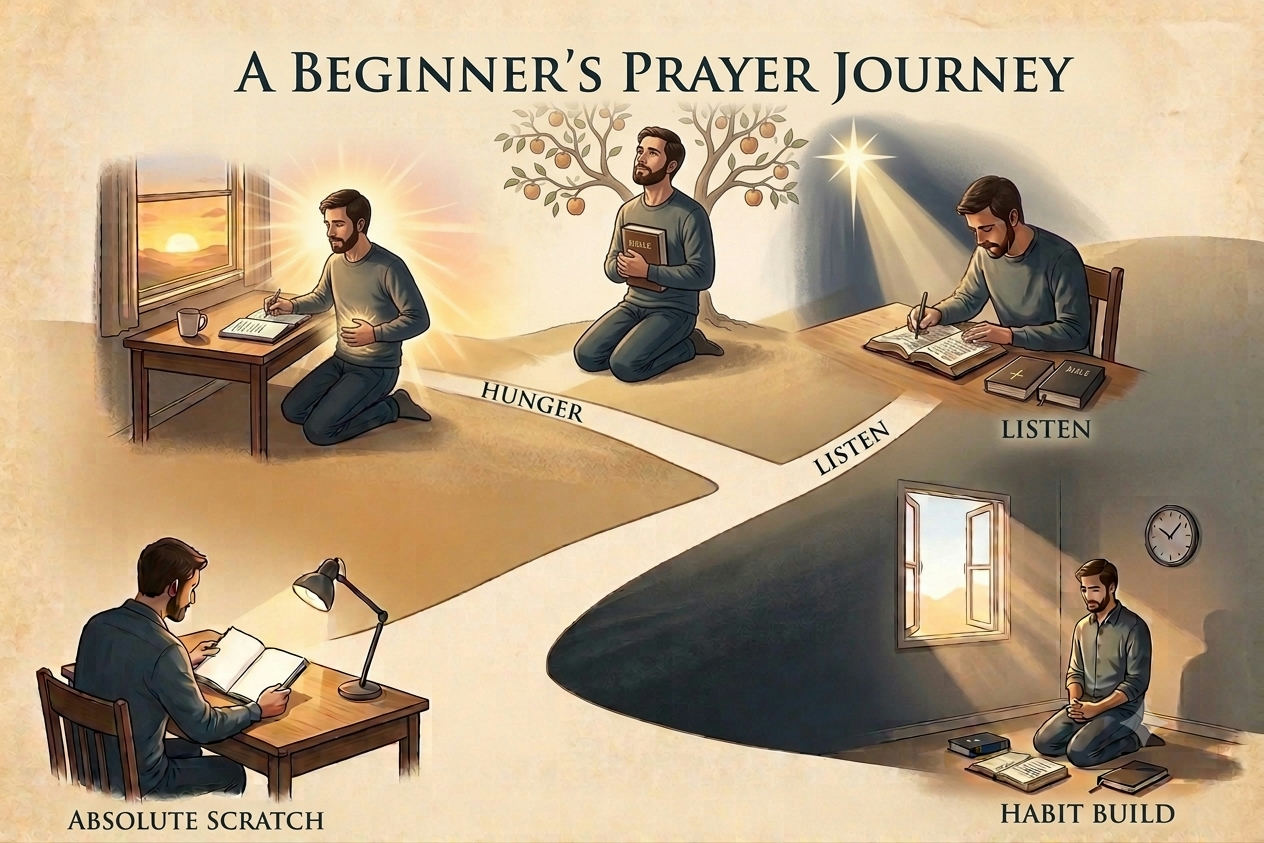
How to Start a Personal Prayer Life From Absolute Scratch
Most people who want to start prayer & fasting don't fail because they lack faith. They fail because nobody told them what to actually do on day one. This article fixes that. You'll get a plain reading of what the Bible says, a realistic look at what fasting feels like, and a first-day plan simple enough to start this week.
Fasting is not a spiritual performance. It's not a diet. And it's not a way to pressure God into answering you. It's a voluntary act of setting something aside, usually food, so that the space it leaves gets filled with prayer instead. That's the whole idea. Everything else builds from there.
Key Takeaways
- Pick one meal to skip this week and use that time to pray instead of eat. That single swap is a complete fast for a beginner.
- Write your reason for fasting down before you start. A clear, specific intention keeps you anchored when hunger makes quitting feel reasonable.
- Read the fasting passages in their context, not just as isolated quotes. Selah lets you pull up Matthew 6, Esther 4, or Daniel 1 with cross-references and commentary in one place, free.
- Tell one trusted person what you're doing. Private fasting is biblical, but accountability to one person is not the same as public performance.
- When you break your fast, do it slowly and with food that's easy to digest. How you end matters as much as how you begin.
On this pageWhat Prayer and Fasting Actually Mean in the BibleWhy This Combination Is More Powerful Than Prayer AloneHow to Choose the Right Type of Fast for a BeginnerA Simple First-Day Plan You Can Actually FollowThe Obstacles That Kill a New Prayer and Fasting PracticeHow to Build This Into a Regular Prayer Life Over Time
What Prayer and Fasting Actually Mean in the Bible
Fasting in Scripture means voluntarily skipping food (or another comfort) for a set time in order to focus on God. Not to earn favor. Not to punish yourself. Just to clear space. Moses fasted 40 days on Sinai while receiving the law (Deuteronomy 9:9). Esther called a 3-day fast for her people before she risked her life approaching the king (Esther 4:16). Jesus fasted 40 days before his public ministry began (Matthew 4:2). In each case, fasting preceded something that required total dependence on God.
The link between prayer and fasting is physical. When hunger hits, your body sends a signal you can't ignore. That signal becomes a prompt. Instead of walking to the kitchen, you stop and pray. Your body's rhythm becomes your prayer schedule. No alarm needed.
Matthew 6:16-18 is the clearest instruction Jesus gives on fasting. He assumes his followers will fast ('when you fast,' not 'if you fast'), and he tells them to do it privately. Wash your face. Don't look gloomy. Don't announce it. The fast is between you and God, not a credential to display.
What fasting is not. Fasting is not a hunger strike aimed at God. It is not required for salvation. It is not a diet with a devotional label. And it does not twist God's arm into giving you what you want. It positions you to seek him with fewer distractions. That's the whole job.
If you want to read the original Hebrew and Greek words behind these passages, the interlinear reader at Selah maps every word to its concordance number for free. Start with Matthew 6:16 and look up the Greek word for 'fasting' (nesteuontes). Seeing the root changes how you read the verse.
Why This Combination Is More Powerful Than Prayer Alone
A scheduled quiet time is easy to skip. Hunger is not. That's the practical advantage of combining prayer with fasting. Your body creates a recurring alarm throughout the day, and each alarm is a chance to pray instead of eat.
The biblical record is consistent on this. Daniel fasted for three weeks and received vision and understanding (Daniel 10:2-12). Nehemiah fasted and wept before making a critical request of the Persian king (Nehemiah 1:4). The early church fasted before sending Paul and Barnabas out as missionaries (Acts 13:2-3). In every case, fasting wasn't the magic ingredient. Attentiveness was. Fasting just made attentiveness easier.
The point isn't that God responds more to hungry people. It's that you show up more focused and less distracted. Daily appetite and routine carry a lot of noise. Fasting lowers that noise for a defined window of time.
One honest note before you start: fasting does not guarantee a specific outcome. It doesn't obligate God to answer in the way you're hoping. It positions you to seek him with fewer things competing for your attention. That's a real benefit. It's just not a transaction. Go in with that expectation and you won't be disappointed when the experience feels quiet.
Read through why prayer matters for fasting if you want a fuller theological picture before your first fast.
How to Choose the Right Type of Fast for a Beginner
Start smaller than you think you need to. That's the most important sentence in this section. A beginner who skips lunch and spends that hour in prayer has done a real fast. You don't need to start with 24 hours of water only.
Three practical options for a first fast: A full fast means water only, typically 12 to 24 hours. A partial fast means skipping one or two meals and eating simply at others. A Daniel fast means vegetables and water only, based on Daniel 1:12, and is usually done over several days or weeks. For a first attempt, a partial fast is the most sustainable starting point.
You can also fast something other than food. Social media, streaming, or a daily habit that consumes your attention are all valid options, especially if you have a medical reason to avoid food restriction. The principle is the same: remove something that competes for your focus and redirect that time to prayer.
Medical conditions matter here. If you have diabetes, are pregnant, or take medication that requires food, do not do a food fast without talking to your doctor first. A non-food fast, giving up social media or entertainment for a day, is a fully legitimate alternative and carries no health risk.
Set a clear start and end time before you begin. Vague intentions collapse by mid-morning. Decide tonight: 'I will skip breakfast and lunch tomorrow and pray during both of those windows.' That's a plan. 'I'll try to fast this week sometime' is not.
A Simple First-Day Plan You Can Actually Follow
Pick one meal to skip. Before that meal would normally happen, open your Bible and read one passage connected to what you're bringing to God. If you're seeking clarity on a decision, read James 1:5. If you're praying for someone who's sick, read James 5:14-15. Let the passage give your prayer something to hold onto.
Write down one specific thing you're seeking before you start. Clarity on a decision. Healing for someone you love. A habit you want broken. Vague fasting produces vague results. A written intention gives your prayer a target and gives you something to look back on later.
Each time hunger hits during the fast, treat it as a prayer prompt. You don't need a formal prayer. Something short and honest works: 'God, I'm hungry and I'm here. I need you more than this meal.' That's a real prayer. Say it and mean it.
End the fast with a short written note. What you prayed. What you sensed, even if it was nothing dramatic. What you want to remember. This record matters more than it feels like it does on day one. In three months, you'll be glad you wrote it down.
Selah is a free Bible study tool that lets you read the relevant passage, look up the original Hebrew or Greek word behind a verse, and explore the full profile of a biblical character who fasted, like Daniel or Esther, including every verse they appear in. It costs nothing and keeps your attention on the text rather than a search engine.
The Obstacles That Kill a New Prayer and Fasting Practice
Distraction is the first enemy. Your phone, your hunger, and your to-do list will all feel urgent the moment you sit down to pray. Name this before you start. Decide in advance what you'll do when it hits. Put your phone in another room. Close the laptop. The decision made ahead of time is the one that holds.
Guilt over 'doing it wrong' stops more beginners than physical hunger does. There is no perfect fast. If you break the fast early, you haven't failed. Resume, keep going, and do it again next week. A broken fast that gets resumed is still a fast. Perfectionism is the thing that actually ends a practice.
Expecting a dramatic experience sets you up to quit. Most fasts feel ordinary. You pray, you're hungry, you pray again, the day ends. The fruit often shows up days later, not during the fast itself. Go in expecting ordinariness and you won't be rattled when that's what you get.
Isolation makes it harder. Telling one trusted person you're fasting adds accountability without turning it into a public performance. Matthew 6:16 warns against announcing your fast to look spiritual. That's different from quietly telling a friend, 'I'm fasting tomorrow, pray for me.' One is performance. The other is community.
Lower the bar to keep the habit. If every obstacle above sounds familiar, shorten the fast. Skip one meal instead of two. Fast one day this month instead of every week. Do it again next month. Consistency over months builds more than one heroic fast followed by six weeks of nothing.
How to Build This Into a Regular Prayer Life Over Time
One fast does not build a prayer life. Consistency over months does. Start with one intentional fast per month. Once that feels natural, move to twice a month. Weekly fasting is a goal to grow into, not a starting requirement.
Pair fasting with a Bible reading plan so your prayer has content to work with. Reading through a Gospel in 40 days, for example, gives you a daily passage to bring into your fast. Prayer without Scripture tends to circle the same few requests. Scripture gives it new ground to cover.
Track your prayers in writing. When you look back in three months and see what you asked for and what happened, your faith grows on evidence, not feeling. That record is more valuable than any devotional book you could buy.
As your practice grows, the character profiles and topics pages on Selah let you study the people in Scripture who prayed and fasted, seeing their full story, family connections, life timeline, and every verse they appear in, all in one place. Seeing Daniel's full arc, not just the fasting verses, changes how you read his prayers.
This is how to start a personal prayer life as a beginner: one skipped meal, one written intention, one honest prayer when hunger hits. That's the whole first step. The practice builds from there, one fast at a time, over months and years. Start this week, not when conditions are perfect.
Frequently asked questions
How long should a beginner's first fast be?
Start with one meal, not a full day. Skipping lunch and using that hour to pray is a real fast. Once a single-meal fast feels natural, try a sunrise-to-sunset fast before attempting anything longer.
Can I drink coffee or tea during a prayer fast?
Most traditional fasts allow water only. Coffee and tea are not prohibited in Scripture, but caffeine can increase anxiety and disrupt the quiet focus fasting is meant to create. If you're doing a partial or Daniel-style fast, unsweetened herbal tea is a reasonable choice.
What do I do if I break my fast early by accident?
Eat the food, then continue the fast. An accidental break does not cancel the day. Guilt over it is a distraction. Acknowledge it, refocus your prayer, and keep going.
Is there a specific Bible verse that commands Christians to fast?
No single verse commands all Christians to fast as a law. Jesus says 'when you fast' in Matthew 6:16, which assumes the practice without making it mandatory. The pattern across both Testaments treats fasting as a natural response to serious need, not a rule to follow on a schedule.
What is the Daniel fast, and is it right for beginners?
The Daniel fast is a partial fast based on Daniel 1:12, where Daniel ate only vegetables and water for ten days. It avoids meat, sweets, and processed food but allows eating throughout the day. It's a good starting point for people with medical conditions or those who can't safely skip meals entirely.
How do I know if my prayer during fasting is actually working?
You probably won't feel a dramatic signal in the moment. What most people notice is a quieter mind, sharper attention to Scripture, and a slower pace of thought. The fruit often shows up days later, not during the fast itself. Track what you prayed for in writing so you can look back.
Read the Fasting Passages in Full ContextSelah gives you every fasting chapter in Scripture alongside Matthew Henry's commentary, Strong's word data, and cross-references, all free, no account required to start reading.Start reading free →
Comments
Be the first to comment.