Is God's Grace a License to Keep Sinning? Paul Answers
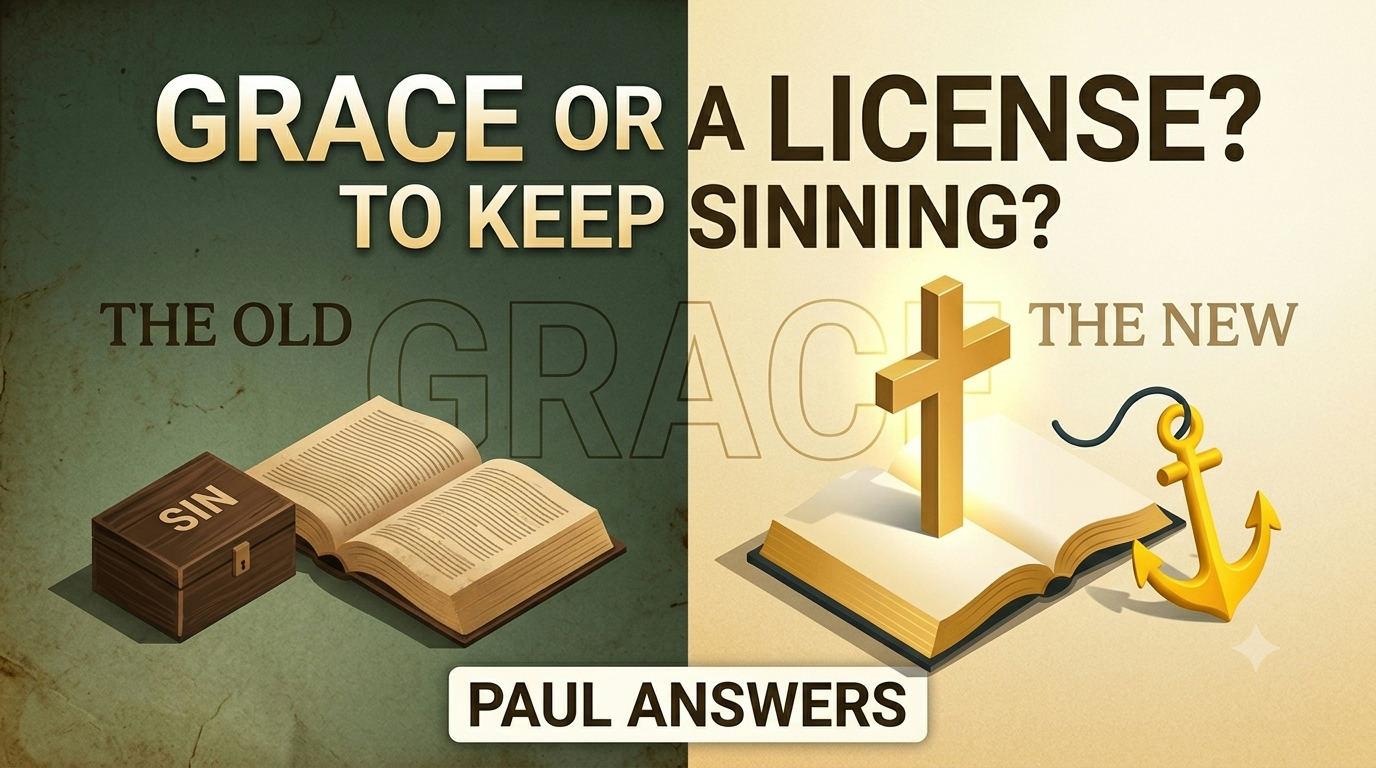
Is God's Grace a License to Keep Sinning? Paul Answers
Grace and forgiveness are not the same thing. Most people use them interchangeably, and that single confusion is behind more spiritual stuck-ness than almost any other mistake in the Christian life. Get the difference clear and the guilt loop breaks. Miss it and you'll either treat grace as a blank check or spend years feeling like God's forgiveness hasn't quite reached you yet.
The question 'is grace a license to sin?' is not a modern invention. Paul heard it in the first century and answered it head-on in Romans 6. His answer is still the clearest one available. But to understand it, you need to know what grace and forgiveness each actually do, and why they are not interchangeable.
Key Takeaways
- When you feel guilty after receiving forgiveness, name the emotion precisely: guilt over a specific act is different from shame about your identity. Treat them differently, because God does.
- Before dismissing someone's offense as 'not a big deal,' read Romans 12:17-21 and ask whether you are releasing the debt or just suppressing the anger. Real forgiveness is a decision, not a feeling that arrives on its own.
- If you are stuck on whether grace permits ongoing sin, read Romans 6:1-14 in a translation you find clear, then look up the Greek word baptizo in a free Strong's concordance to see what Paul's 'buried with Christ' metaphor actually means.
- The next time you need to forgive someone who has not apologized, separate two questions: 'Do I release my right to retaliate?' and 'Do I trust this person again?' The first is required. The second depends on their actions.
- Use a Bible study tool that shows original-language data alongside the text so you can verify what words like charis (grace) and aphiemi (forgiveness) actually mean in context, rather than relying on English alone.
On this pageGrace and Forgiveness Are Not the Same Word for the Same ThingWhat Romans 6 Actually Says (and What Paul Was Responding To)Why Grace Doesn't Cancel Consequences — and Was Never Meant ToWhy You Can't Forgive Yourself (and What Grace Has to Do With It)How Grace and Forgiveness Work Together in Daily LifeWhat the Original Greek Words Reveal About Grace and Forgiveness
Grace and Forgiveness Are Not the Same Word for the Same Thing
Grace is God's unearned favor toward you. It exists before you do anything right or wrong. Forgiveness is the specific act of canceling a debt you actually owe. Grace is the reason the door is open. Forgiveness is what happens when you walk through it after you've made a mess.
Paul ties them together in Ephesians 1:7: 'In him we have redemption through his blood, the forgiveness of sins, in accordance with the riches of his grace.' Notice the structure. Grace is the source, the riches from which forgiveness flows. Forgiveness is the specific transaction. One funds the other; they are not the same thing.
Confusing them creates two opposite problems. Some people treat grace as permission to sin freely, reasoning that more sin just means more grace to cover it. Others can't accept forgiveness because they feel they haven't been good enough to deserve grace first. Both errors come from the same root: treating grace and forgiveness as one blurry concept instead of two distinct realities.
Grace doesn't require you to be good first. Forgiveness doesn't require you to feel worthy afterward. Knowing which is which stops both errors cold. Start there: every time you feel the guilt loop starting, ask yourself which one you're actually confused about.
What Romans 6 Actually Says (and What Paul Was Responding To)
Paul opens Romans 6 with a question someone in his audience was already asking out loud: 'Shall we go on sinning so that grace may increase?' He is not raising a hypothetical. People were genuinely making this argument. His answer is the Greek phrase me genoito, the strongest negative available to him. It translates roughly as 'Absolutely not' or 'God forbid.' Not 'well, it's complicated.' A flat no.
His reasoning is structural, not moral. If you've been united with Christ in his death and resurrection, you have died to the power sin had over you. You're not just forgiven of past sins. Your relationship to sin has changed at a deeper level. Sinning freely would contradict the transformation that grace already started in you.
The indicative drives the imperative. Paul's argument in Romans 6 isn't 'try harder to be better.' It's 'remember what actually happened to you.' The indicative (what is already true about you in Christ) is what drives the imperative (what you now do). You don't earn the new identity; you live from it.
The license-to-sin reading misunderstands what grace does. Grace doesn't just cover the penalty for sin; it begins remaking the person receiving it. A person who uses grace as permission to sin hasn't understood grace. They've understood a discount code.
Read Romans 6:1-14 slowly and notice that Paul never says 'try not to sin.' He says 'count yourselves dead to sin.' That's a posture of memory and identity, not willpower. The practical step: the next time you're tempted, don't reach for more effort. Reach for the fact of what happened to you in Christ.
Why Grace Doesn't Cancel Consequences — and Was Never Meant To
Forgiveness removes guilt before God. It does not erase every earthly consequence of a choice. David is the clearest example in Scripture. After his sin with Bathsheba, the prophet Nathan told him plainly that God had forgiven him (2 Samuel 12:13). The child still died. His household never fully recovered. Forgiveness was real. The fallout was also real.
This is not a contradiction of grace. Grace absorbs the eternal penalty. It does not always absorb the natural fallout of broken trust, damaged relationships, or physical harm. These are two different categories: your standing before God (fully restored by grace through faith) and your life in the world (still subject to cause and effect).
Knowing this actually makes grace more honest, not less generous. God is not pretending the sin didn't happen. He is dealing with it at the deepest level while leaving real-world consequences to do their work. That's not cruelty; it's integrity.
A practical test: if a friend forgives you for lying to them, the forgiveness is real even if they need time to rebuild trust. The relationship is restored in principle; the trust is rebuilt in practice. Grace works the same way, just at a scale you can't fully measure. If you're carrying guilt about consequences that are still unfolding, separate the question of God's verdict (settled) from the question of earthly repair (ongoing).
Why You Can't Forgive Yourself (and What Grace Has to Do With It)
Self-forgiveness is one of the most searched phrases in Christian circles. It almost never appears in the Bible as a command. The reason: Scripture doesn't frame forgiveness as something you grant yourself. You are not the final judge of your own case.
The guilt that lingers after God's forgiveness is often not a spiritual deficit. It's a sign you take the sin seriously. That's not a bad thing. The problem is when guilt becomes a permanent residence instead of a passing conviction. There's a difference between godly sorrow, which leads somewhere, and self-condemnation, which just loops.
Accepting grace means agreeing that God's verdict overrules your internal court. The block to self-forgiveness is usually one of two things: you don't fully believe the forgiveness is real, or you believe it's real but feel you should still suffer to make it feel earned. Both are a form of adding works to grace. Both treat your feelings as a higher authority than God's word.
Romans 8:1 is not a feeling you manufacture: 'There is now no condemnation for those who are in Christ Jesus.' It is a fact you return to when the guilt resurfaces. The move is not to feel better first and then believe it. The move is to state the fact and let the feeling follow over time. When guilt comes back for a sin you've already confessed, name it, point it to Romans 8:1, and move.
How Grace and Forgiveness Work Together in Daily Life
Grace is the ongoing atmosphere. Forgiveness is the specific event. You live inside grace the way you live inside air. You receive forgiveness the way you take a breath after being underwater. Both are always available; they work at different moments.
When you sin as a believer, you don't lose your standing before God. But the relationship benefits from the specific act of confession and forgiveness to feel clear again. 1 John 1:9 is written to believers for exactly this reason: 'If we confess our sins, he is faithful and just and will forgive us our sins and purify us from all unrighteousness.' That verse is not about getting saved again. It's about breathing.
This is where the license-to-sin question collapses in practice. A person who genuinely lives inside grace becomes more sensitive to sin, not less. The closer you are to a light source, the more clearly you see the dirt. Grace doesn't make sin feel fine; it makes sin feel out of place.
Forgiving others follows the same logic. You extend forgiveness not because the other person deserves it, but because you've received something you didn't deserve. Grace funds the forgiveness you give away. You can't give what you haven't received, which is why people who resist accepting grace often find it hardest to forgive others. One concrete practice: when guilt returns for a sin already confessed, treat it as a memory, not a verdict. Name it, point it back to 1 John 1:9, and move on. That's grace working in real time.
What the Original Greek Words Reveal About Grace and Forgiveness
The Greek word for grace is charis. In the culture of Paul's first readers, charis described a gift given freely by someone of higher standing, with no obligation placed on the recipient. It was not a religious word invented by Christians. It was a word everyone already understood. Paul took it and applied it to God's posture toward humanity.
The primary Greek word for forgiveness is aphiemi, which literally means 'to send away' or 'to release.' When the New Testament says your sins are forgiven, it uses a word that means they have been sent away from you. Not covered over. Not filed. Sent away.
These two words do not overlap. Charis describes the character and posture of God toward you. Aphiemi describes the specific legal and relational act of releasing the debt. One is the environment; the other is the action that happens inside it.
Understanding aphiemi makes the license-to-sin argument even weaker. If forgiveness means your sins have been sent away, deliberately piling them back up isn't freedom. It's dragging back what's already been released. You can study both words in their original context using the Strong's interlinear reader on Selah, which maps every English word to its Hebrew or Greek root without requiring any language training.
Grace and forgiveness are not competing ideas, and they are not synonyms. They are two distinct realities that work together: one describes who God is toward you, the other describes what he does about the specific debt. Getting that straight doesn't make the Christian life easier in the sense of requiring less of you. It makes it clearer. And clarity, in the end, is what breaks the guilt loop and answers the license question in a way that actually holds up on a Tuesday morning when you've just failed again.
Frequently asked questions
Does grace mean God will forgive me no matter how many times I repeat the same sin?
Yes, God's forgiveness is not capped by repetition, but that answer comes with a serious qualifier. Repeated sin with no desire to change raises the question Paul asks in Romans 6:1: are you treating grace as permission? Forgiveness restores the relationship; it does not remove the natural consequences of a pattern, and it does not mean the Holy Spirit stops convicting you.
What is the difference between mercy, grace, and forgiveness?
Mercy is God withholding the punishment you deserve. Grace is God giving you favor you have not earned. Forgiveness is the specific act of canceling the debt your sin created. Think of it this way: mercy stops the penalty, grace opens the door, and forgiveness clears the record. All three are distinct, and the Bible uses different words for each.
If God has already forgiven me, why do I still feel guilty?
Guilt that persists after genuine confession is usually one of two things: either it is the Holy Spirit pointing to a pattern that still needs to change, or it is shame (a verdict about your worth) rather than guilt (a signal about an act). God's forgiveness addresses the act. Shame requires a separate work, often involving renewing how you see yourself in light of what Scripture says about your identity in Christ.
Can a Christian lose their salvation by treating grace as a license to sin?
This is one of the most debated questions in Christian theology, and honest teachers land in different places. What Romans 6 makes clear is that treating grace as permission to sin misunderstands what grace actually does: it unites you to Christ's death and resurrection, which changes what you want, not just what you are allowed to do. Whether that misunderstanding can cost someone their salvation depends on your theological tradition, but Paul's point is that the question itself reveals a category error.
How do I forgive someone who has never apologized or shown remorse?
Forgiveness toward an unrepentant person is a one-sided release of your right to retaliate or hold the debt. It does not require their participation, and it does not mean pretending the harm did not happen. It is closer to what Jesus did from the cross in Luke 23:34 than to a mutual reconciliation. Reconciliation requires two people; forgiveness only requires one.
Is self-forgiveness a biblical concept?
The phrase 'self-forgiveness' does not appear in Scripture, but the experience it points to is real. What the Bible addresses is receiving the forgiveness God has already granted rather than continuing to prosecute yourself after God has dropped the charges. First John 3:20 speaks directly to a condemning heart: 'God is greater than our heart.' The practical move is not to forgive yourself as a separate act, but to stop overruling God's verdict with your own.
Study Grace and Forgiveness in the Original LanguagesSelah gives you the full Bible text, Strong's interlinear data for every Hebrew and Greek word, Matthew Henry's commentary, and 8,000+ dictionary entries — all free, no account required. Look up charis, aphiemi, and Romans 6 side by side right now.Start studying free →
Comments
Be the first to comment.