What Is Sin According to the Bible Beyond the Common Definition
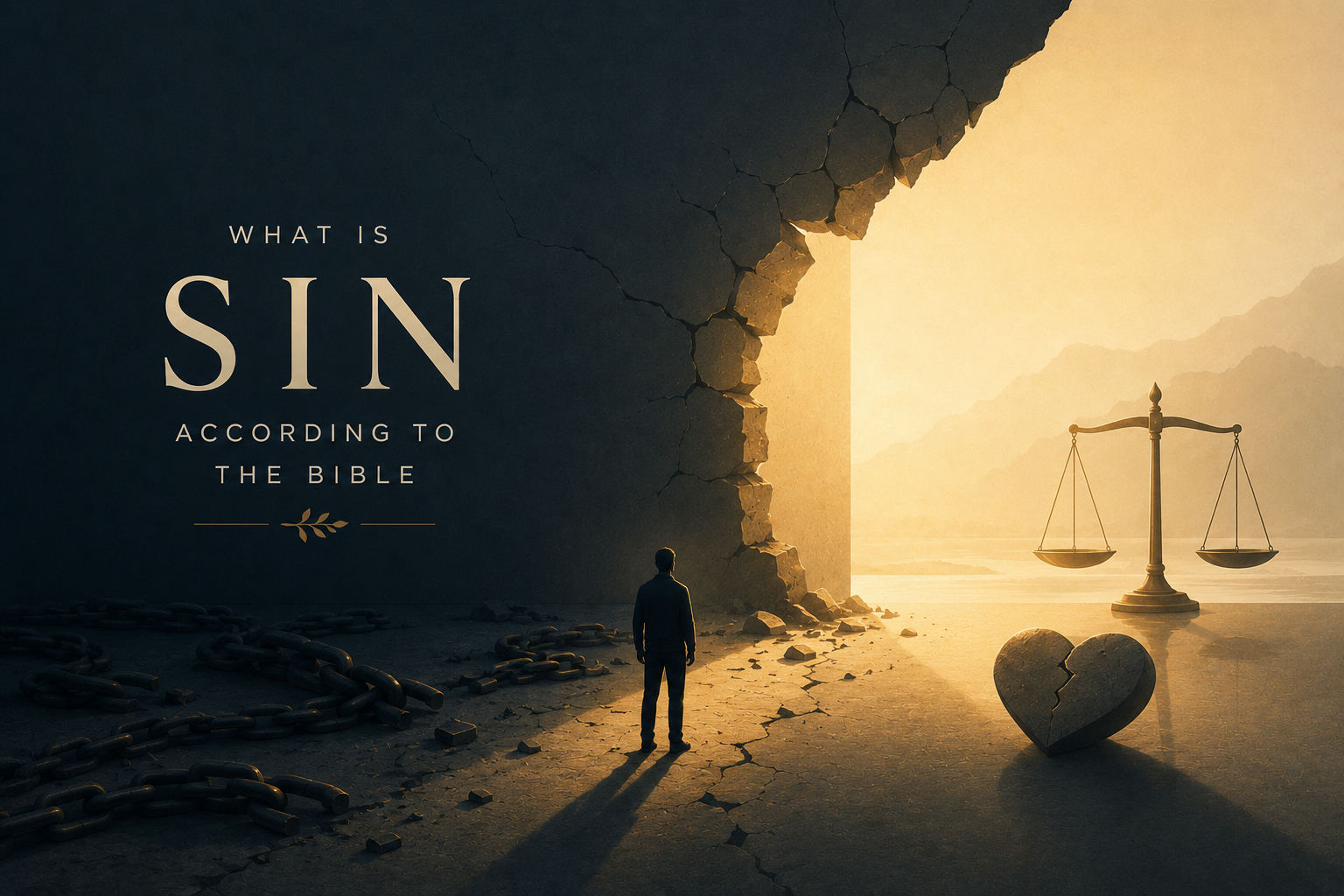
What Is Sin According to the Bible Beyond the Common Definition
Most people think sin, heaven, & hell are simple: do bad things, go to hell; do good things, go to heaven. Scripture tells a different story. The Bible's picture is about direction and relationship, not a scorecard. Get that wrong and you'll misread almost every passage that touches these three topics.
The question 'where is heaven?' assumes heaven is a place inside the universe, like a city you could theoretically fly to. And 'what is sin according to the Bible deeper definition' reveals that sin is not just a list of broken rules but a broken aim. These are not small distinctions. They change how you read the whole Bible.
Key Takeaways
- Read Romans 3:23, James 4:17, and Psalm 51:5 back to back — those three verses alone give you a fuller picture of sin than most sermons cover in a year.
- When you hit a passage about heaven or hell, note the original word used (Sheol, Hades, Gehenna, Paradise, New Jerusalem) before drawing any conclusions about what the text is actually describing.
- If you want to trace what the Bible says about a specific person's eternal fate, look up their full character profile rather than relying on a single verse taken out of context — Selah has 272+ profiles that include every verse a biblical figure appears in.
- Use an interlinear reader at least once on a key passage about sin or judgment — seeing the Greek or Hebrew word behind the English translation will permanently change how you read those texts.
- Treat your own study of these topics as ongoing, not settled. The Bible's language around sin, heaven, and hell is layered enough that returning to the same passages a year later almost always surfaces something new.
On this pageSin Is More Than Breaking Rules: What the Bible Actually DefinesWhere Heaven Is in the Bible (And Why It's Not a Location on a Map)Where Hell Is in the Bible: Sheol, Hades, Gehenna, and Why They're Not the Same PlaceSin Is What Separates: The Real Connection Between Sin, Heaven, and HellHow to Know Your Own Destination: What the Bible Says You Can Be Sure OfReading the Hard Passages About Sin and Judgment Without Getting Lost in Metaphor
Sin Is More Than Breaking Rules: What the Bible Actually Defines
Sin is a broken aim before it is a bad act. The Hebrew word chata and the Greek word hamartia both translate literally as 'missing the mark,' the way an archer misses a target. Romans 3:23 says everyone 'falls short of the glory of God.' That's not about behavior alone. It's about orientation. What are you aimed at?
James 4:17 adds a second layer that most people overlook: knowing the right thing and not doing it is also sin. Sin is both active (doing what you shouldn't) and passive (failing to do what you should). That makes it much harder to dismiss with a short list of obvious wrongs.
The Bible also treats sin as a condition before it treats it as an action. Psalm 51:5 and Romans 5:12 describe sin as something humans are born into. You don't become a sinner by sinning; you sin because you are already, by nature, turned away from God. That's a harder claim than most people want to sit with, but it's what the text says.
Two questions for any sin passage. When you read any passage about sin, ask two questions: What relationship is being broken here? And what was the person aiming at instead of God? Those two questions will get you further than a list of rules.
Where Heaven Is in the Bible (And Why It's Not a Location on a Map)
Heaven in Scripture is not a GPS coordinate. The Bible uses three distinct words translated as 'heaven': the Hebrew shamayim (sky and atmosphere), the Greek ouranos (the sky, the cosmos, and God's dwelling), and the 'third heaven' Paul mentions in 2 Corinthians 12:2, which is God's own presence. These are not three names for the same place. They describe different realities.
Jesus uses the phrase 'the kingdom of heaven' more than 30 times in Matthew alone. He consistently frames it as a state of being under God's reign, not a location. When he says 'the kingdom of heaven is like a mustard seed,' he is describing how God's rule works, not drawing a map.
Revelation 21 flips the popular image entirely. The New Jerusalem does not stay up in the sky. It comes down to a renewed earth. The final 'heaven' in Scripture is not a place you ascend to; it's a reality God brings to creation. That's why Jesus teaches his disciples to pray 'your kingdom come, your will be done, on earth as it is in heaven.' The direction is downward, not upward.
When you read a passage about heaven, notice whether it's describing God's presence or a physical location. Most of the time, it's the former. That single observation will keep you from misreading dozens of passages.
Where Hell Is in the Bible: Sheol, Hades, Gehenna, and Why They're Not the Same Place
Sheol and Hades: The Place of the Dead
Sheol in the Old Testament and its Greek equivalent Hades in the New Testament describe the state of the dead generally. Not a place of punishment specifically. Both words point to the realm where the dead exist, without the strong moral coloring that the English word 'hell' carries. Conflating them with Gehenna is where popular theology gets confused.
Gehenna: The Word Jesus Actually Used
When Jesus warns about hell in Matthew 5:22 and 10:28, the word he uses is Gehenna. This was a real place: the Valley of Hinnom, just outside Jerusalem's walls, where garbage burned continuously. His audience knew exactly what he meant. It was not a vague metaphor for a bad feeling. It was a vivid, concrete image of something that consumed what was thrown into it and never stopped burning.
There is also Tartarus, used once in 2 Peter 2:4 to describe where fallen angels are held. It appears nowhere else in the New Testament and refers to a specific state of confinement, not the general destination of the unrighteous.
The Lake of Fire: Revelation's Final Picture
Revelation 20:14 describes 'the lake of fire' as the 'second death.' This is the final state after judgment, and it is distinct from Hades. The Bible's picture of hell is not one static place. It's a progression: Sheol/Hades as the intermediate state, Gehenna as Jesus's image of final judgment, and the lake of fire as Revelation's end-point.
Check the original word first. When you see the word 'hell' in your Bible, look up which original word it translates. Sheol, Hades, Gehenna, and Tartarus are four different realities. That single step will clarify more than most commentaries on the topic.
Sin Is What Separates: The Real Connection Between Sin, Heaven, and Hell
Isaiah 59:2 states it plainly: sin separates people from God. Heaven and hell in Scripture are not primarily about reward and punishment as transactions. They are about the presence or absence of God. That reframe changes everything.
C.S. Lewis captured the biblical logic well: hell is not God sending people away so much as God allowing people to have what they chose, which is existence without him. That matches Romans 1:24-28, where God 'gives people over' to what they pursued. The direction of a life, not a single act, is what Scripture describes as leading to life or destruction (Matthew 7:13-14).
The parable of the rich man and Lazarus in Luke 16:19-31 is the Bible's clearest picture of the gap between the two destinations. The rich man's problem was not dramatic evil. It was indifference: to God, to the suffering man at his gate, to any reality beyond his own comfort. That's a more uncomfortable diagnosis than a list of crimes.
Read Luke 16:19-31 in one sitting and ask: what did each man's daily life aim at? That question gets closer to the Bible's logic than any question about geography.
How to Know Your Own Destination: What the Bible Says You Can Be Sure Of
1 John 5:13 is direct: 'I write these things to you who believe in the name of the Son of God so that you may know that you have eternal life.' The Bible treats assurance as possible, not arrogant. You are not presuming by asking the question.
The basis of that assurance is not moral performance. John 17:3 defines eternal life as knowing God and Jesus Christ. That's relational language. Romans 8:1 states there is 'no condemnation for those who are in Christ Jesus.' The condition is being in Christ, which the New Testament describes as faith and trust, not a checklist of sins avoided.
The honest counterpoint: Hebrews 10:26-27 and Matthew 7:21-23 warn that profession without genuine relationship is not enough. The Bible holds assurance and self-examination together. They are not contradictions. They are two sides of genuine faith. You can be confident and still take the question seriously.
If you want to test your own direction, use 1 John as a mirror. It was written specifically for that purpose and gives concrete markers, not vague feelings. Read it slowly, one chapter at a time.
Reading the Hard Passages About Sin and Judgment Without Getting Lost in Metaphor
The Bible uses vivid imagery for both heaven and hell: streets of gold, a lake of fire, outer darkness, a wedding feast. These images are meant to communicate reality, not to be taken as literal architecture. The question is always: what truth about God or human experience is this image pointing to?
Fire in Scripture consistently signals purification or judgment. Darkness signals separation from God, who is described as light. When you see those images, ask what they are communicating about the nature of the experience, not what the temperature is.
The word 'eternal' in phrases like 'eternal punishment' (Matthew 25:46) translates the Greek aionios, which can mean 'of the age to come' as well as 'without end.' Scholars debate the scope. What they agree on is that the consequences are real and serious. The debate is about duration, not reality.
Tools like the Strong's interlinear reader on Selah let you look up the original Greek or Hebrew word behind any translation in seconds. Pick one passage about judgment that has always confused you and look up every key word in its original language. You will almost always find that the confusion came from the English translation, not the text itself.
Sin, heaven, and hell are not three separate topics in Scripture. They are one story: a broken aim, a separation, and two destinations defined entirely by relationship to God. The geography question is the wrong question. The right question is the one the Bible keeps asking: what are you aimed at, and who are you with?
Selah gives you the full reader, Strong's interlinear, character profiles, and Matthew Henry's commentary in one place, all free, so you can keep reading without hitting a paywall every time a passage gets interesting.
Frequently asked questions
Can someone who has sinned greatly still go to heaven?
Yes, according to the Bible. Romans 5:20 says where sin increased, grace increased even more. The thief crucified next to Jesus had no time for good works or religious practice, yet Jesus told him directly, 'Today you will be with me in paradise.' The consistent biblical pattern is that the deciding factor is trust in Christ, not the size of the sin record.
What is the unforgivable sin Jesus mentions?
Jesus calls it blasphemy against the Holy Spirit in Matthew 12:31-32. Most scholars understand this as a persistent, final rejection of the Spirit's work — attributing what God is clearly doing to evil. It is not a single careless word or a moment of doubt. The very fact that someone worries they have committed it is generally taken as evidence they have not, since hardened rejection leaves no room for that concern.
Is hell a real physical place or a spiritual state?
The Bible uses at least three distinct words translated as 'hell' in English: Sheol (the Hebrew realm of the dead), Hades (its Greek equivalent), and Gehenna (a specific valley outside Jerusalem that Jesus used as an image of final judgment). Revelation 20 describes a 'lake of fire' as a future, post-resurrection reality. Whether that is literal geography or vivid imagery for a real spiritual condition is a question theologians have debated for centuries — but the Bible treats the consequence as genuinely serious either way.
Is Judas in heaven or hell according to the Bible?
The Bible does not give a direct verdict. Jesus calls Judas 'the son of destruction' in John 17:12, and Acts 1:25 says he went 'to his own place' — language that most readers take as grim. But the text stops short of an explicit statement of eternal destination. Judas is one of the clearest examples of why reading a full character profile, including every verse he appears in, matters more than pulling two or three lines.
What does the Bible say exists between heaven and hell?
The Bible does not describe a neutral middle zone in the way popular culture imagines it. Jesus's parable of the rich man and Lazarus in Luke 16 mentions 'a great chasm' that cannot be crossed between the two sides. Some traditions point to concepts like Sheol or Hades as an intermediate state before final judgment, but Scripture does not map out a geography with labeled regions between the two destinations.
Study Sin, Heaven, and Hell in the Original LanguagesSelah gives you a free interlinear reader, 8,000+ term Bible dictionary, and Matthew Henry's full commentary — so you can trace every word behind these topics straight to the Hebrew and Greek without a paywall.Start studying free →
Comments
Be the first to comment.