When Love Becomes Devotion: A Biblical Devotion About Love

When Love Becomes Devotion: A Biblical Devotion About Love
A devotion about love that stays at warm feeling is only half the story. The Bible is not interested in love as a mood. It tracks love as a movement: from affection, through decision, into a life restructured around someone else. That movement is what Scripture calls devotion, and it is available to anyone willing to trace it.
Most of us treat love as something that happens to us and devotion as a personality trait some people are born with. Neither is true. The biblical record shows ordinary people, in ordinary pressure, making a specific decision that turned their love into something that cost them. You can see it in Ruth's words to Naomi, in Jonathan stripping off his armor, in Mary kneeling at Jesus' feet again and again. The pattern repeats because it is the pattern.
Key Takeaways
- Pick one biblical figure whose love became costly action — Ruth, the Good Samaritan, Mary of Bethany — and read their story this week with that specific question in mind: where did the feeling stop and the decision begin?
- The next time you feel love for someone but hesitate to act, name the hesitation out loud. That gap between feeling and action is exactly where devotion either forms or doesn't.
- Look up the Hebrew word hesed in a free Bible dictionary, such as the one at Selah, and trace it through three or four Old Testament passages. The pattern across those verses will teach you more than any single definition.
- Choose one person in your life and commit to one concrete act of love this week that costs you something — time, comfort, or convenience. That is the practice the biblical writers are describing, not a feeling to wait for.
- If you want to go deeper than a single devotion, read a full chapter in its original context using an interlinear reader so you can see what the Hebrew or Greek word actually is before the translator made a choice.
On this pageThe Difference Between Loving Someone and Being Devoted to ThemHow Ruth Moved from Affection to Total Commitment in One SentenceThree Other Biblical Figures Who Show the Same ProgressionWhat Breaks the Progression and How to Recognize It in YourselfA Practical Way to Use Scripture to Move from Love to DevotionWhere Loving God and Loving People Become the Same Act
The Difference Between Loving Someone and Being Devoted to Them
Devotion is love that has made a decision. That is the working definition you can actually test. You can love your neighbor and still cross the street. The Good Samaritan in Luke 10:33-34 did not just feel compassion; he stopped, knelt, and bandaged the wound. He paid for the inn. The feeling came first, but the devotion was in the stopping.
The Hebrew word hesed (pronounced kheh-sed) is the closest Scripture gets to naming this moment. It is usually translated as loving kindness or covenant love, but what it really describes is loyal action taken even when the feeling has faded. God's hesed toward Israel does not waver when Israel wanders. It is not emotional; it is covenantal. It is love that has already decided.
A devotion that stops at warm emotion misses the point. Biblical love always moves toward a cost. The question is not whether you feel love for God or for the people around you. The question is whether that love has reached the decision point yet, and whether your life looks any different because of it.
Read Luke 10:30-37 this week. After you read it, ask yourself: in which relationship am I still on the other side of the street?

How Ruth Moved from Affection to Total Commitment in One Sentence
Ruth 1:16-17 is the clearest single picture of love becoming devotion in the entire Bible. 'Where you go I will go, and where you stay I will stay.' That is not a feeling. It is a binding declaration made under no pressure to stay. Naomi had already released Ruth twice. She gave her every reasonable exit. Ruth's choice was counted, not impulsive.
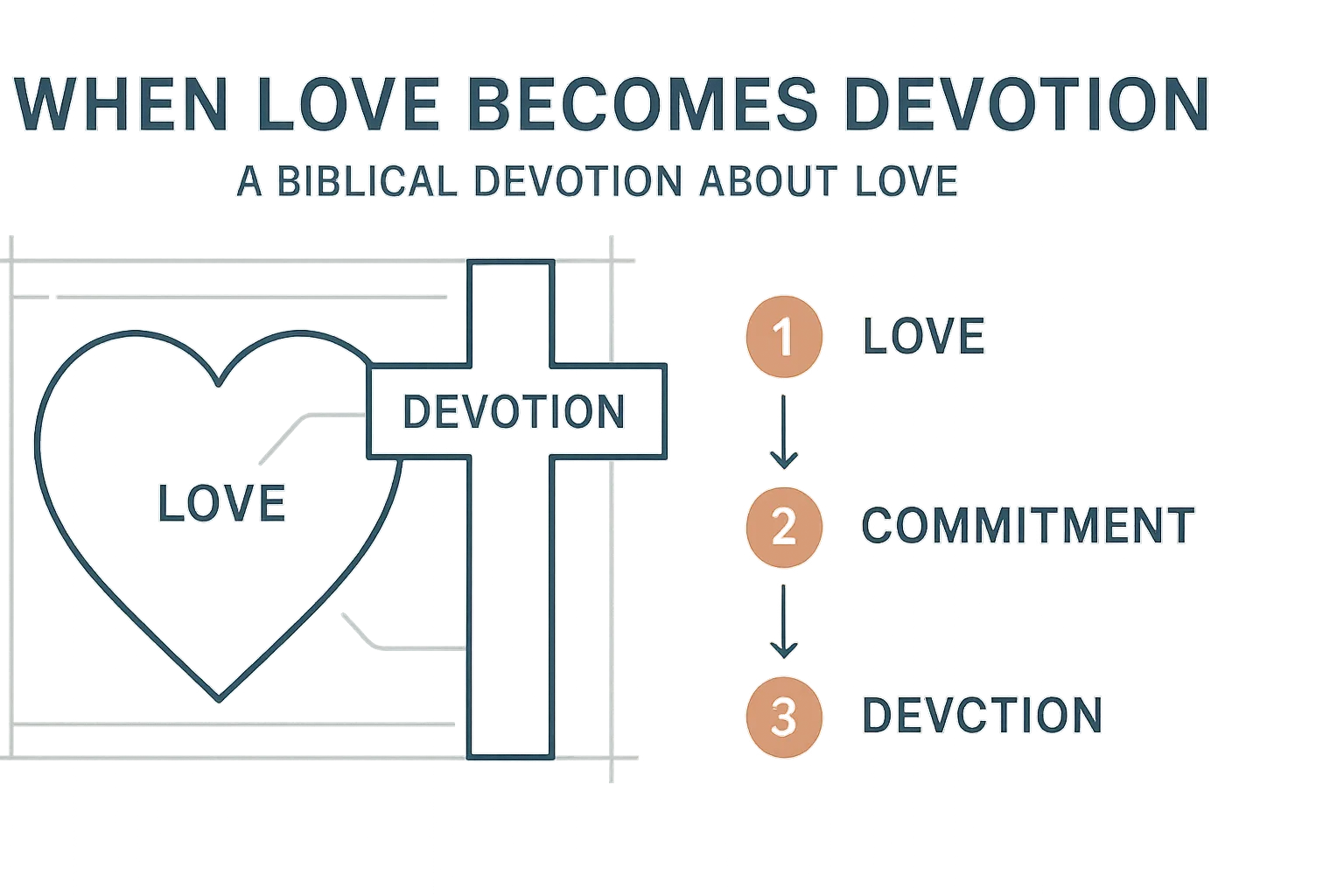
The progression is visible in the text. Ruth loved Naomi (affection). She chose to stay when she could have left (decision). She then reorganized her entire life around that choice: new country, new people, new God, new future (devotion). Three stages. Affection, decision, reorganization. That arc is the pattern Scripture keeps returning to.
Map the three stages to your life. Think of one relationship where you feel genuine affection. Ask honestly: have you made a decision about it, or are you still waiting to feel more certain? And if you have decided, has anything in your actual week changed because of it? The stage you are stuck at is the one to bring to Scripture.
Ruth did not know how the story would end. She did not have the book of Ruth to read. She made the decision before the harvest, before Boaz, before any of the blessing arrived. That is what makes her arc trustworthy as a model. Identify which stage you are actually at in one relationship right now, and name it honestly.
Three Other Biblical Figures Who Show the Same Progression
David and Jonathan: When Friendship Crosses Into Covenant
In 1 Samuel 18:3-4, Jonathan stripped off his robe, his armor, his sword, his bow, and his belt and gave them all to David. This was not a sentimental gesture. Armor was identity and status in that culture. Jonathan was a prince handing his claim to a shepherd. That act turned affection into covenant in one public, costly moment.
Mary of Bethany: When Worship Becomes the One Thing
Mary of Bethany appears three times in the Gospels, and every single time she is at Jesus' feet. Luke 10, John 11, John 12. That repeated posture is not an emotional high. It is devotion made visible through habit. In John 12, she pours out a jar of pure nard worth a year's wages. The disciples call it waste. Jesus calls it beautiful. The difference is that they were calculating; she had already reorganized her priorities.
Paul: When Conviction Becomes a Life Spent
'To live is Christ, to die is gain' (Philippians 1:21) is not a slogan Paul printed on a banner. It is the logical endpoint of a love that has already restructured every priority. Paul had status, education, and a career. He counted them as loss (Philippians 3:8). The decision came on the Damascus road. The reorganization took the rest of his life. Each of these three figures follows the same arc: initial love, a moment of decision under pressure, and a life restructured around that decision. Find the figure whose arc feels closest to where you are right now.
What Breaks the Progression and How to Recognize It in Yourself
The most common stall point is between decision and reorganization. People genuinely decide to love God more, or to love a person more deeply, and then nothing in their schedule, spending, or habits actually changes. The decision was real. The reorganization never happened. That gap is where devotion dies quietly.
Peter's denial in Luke 22:54-62 is the clearest case in the Gospels. His love for Jesus was not fake. He had left his fishing nets. He had walked on water. But under pressure in the courtyard, his life was still structured around self-preservation. The reorganization had not caught up with the decision yet. He wept bitterly because he knew it.
Restoration is part of the pattern too. In John 21, Jesus asks Peter three times: 'Do you love me?' Not to shame him. To walk him back through the progression. Each question is a step: do you love me, do you love me, do you love me? Each answer is followed by a command: feed my sheep. Love expressed as action, not as feeling.
A devotion with no cost is a diagnosis. If your love for God or for someone close to you has never cost you anything specific, that is not a failure. It is information. It tells you the love is real but has stalled at affection. The honest question to ask is: what would have to change in my week if this love became devotion?
Write down one specific thing that would look different in your week if your love for God became devotion. One thing. Not a list.
A Practical Way to Use Scripture to Move from Love to Devotion
Reading Scripture as a devotion about love works best when you read with a specific relationship in mind. Not abstractly. Ask the passage a concrete question: what does this text ask me to do for this person this week? That question changes how you read.
The interlinear tools on Selah let you look up hesed or agape (the Greek word for self-giving love) in their original Hebrew and Greek context. When you see that agape in 1 Corinthians 13 is built from the same root as the love God shows in John 3:16, familiar verses stop being decorative and start being instructive.
Matthew Henry's Complete Commentary, available free on the same platform, is especially useful for Ruth 1, 1 Samuel 18, and John 21. Henry traces the relational stakes the original audience would have felt, which helps you hear the cost each figure was actually paying, not just the spiritual lesson layered on top afterward.
- Read the passage with one specific relationship in mind.
- Identify the cost the biblical figure paid in that text.
- Name one equivalent cost you could pay for that person this week.
This three-step practice is what separates a devotion that changes behavior from one that only changes mood. Try it with Ruth 1:16-17 today.
Where Loving God and Loving People Become the Same Act
Jesus collapses the two great commandments into one logic in Matthew 22:37-40. Love God with everything, and love your neighbor as yourself. He does not present these as parallel tracks. He says the second is like the first. They are the same movement at different scales.
1 John 4:20 is blunt about what happens when they split apart: if you claim devotion to God but treat the person in front of you with contempt, the devotion is not real yet. John does not soften this. He calls it a lie. The test of your love for God is not the length of your prayers. It is the specific, costly thing you do for the person in front of you.
The biblical figures who show the deepest love for God are also the ones whose love for people is most specific and most expensive. Ruth's devotion to Naomi and her devotion to Naomi's God are inseparable in the text. Mary's worship at Jesus' feet and her grief over Lazarus are the same posture. Paul's love for Christ and his willingness to be 'all things to all people' (1 Corinthians 9:22) come from the same source.
Pick one relationship this week where love has stalled at affection. Do one specific, costly thing for that person. Not because it will feel good, but because devotion is love that has already decided.
Frequently asked questions
What is the difference between love and devotion in the Bible?
Love in Scripture is often the feeling or the initial pull toward someone. Devotion is what love looks like after it has made a decision and paid a cost. The Good Samaritan felt compassion first, but his devotion showed up in the bandaging, the inn, and the money left behind. One is the spark; the other is the fire that keeps burning when the spark is gone.
What does hesed mean, and why does it matter for understanding love?
Hesed is a Hebrew word usually translated as lovingkindness or steadfast love, but it carries the specific idea of loyal action taken inside a covenant relationship, even when feelings have cooled. It is the word used when God keeps showing up for Israel after Israel has walked away. Understanding hesed reframes love from a mood into a commitment with teeth.
Can devotion exist without love, or does love always come first?
The biblical pattern almost always shows love arriving before devotion, because devotion is love that has been tested and chosen. Duty without affection is closer to obligation than to the hesed the Bible describes. That said, the act of devoted behavior can rekindle love that has grown cold, which is why Scripture sometimes commands action before it commands feeling.
What is a devotional, and how is it different from just reading the Bible?
A devotional is a short, focused reflection built around one passage or theme, designed to move you from reading to application in a single sitting. Reading the Bible straight through gives you the full story; a devotional slows you down at one verse and asks what it means for today. Think of it as the difference between walking through a museum and sitting with one painting for twenty minutes.
How did Jesus show devotion, not just love, in the Gospels?
Jesus consistently moved from stated love to costly action: washing feet the night before his arrest, stopping for blind Bartimaeus when the crowd told him to keep moving, weeping at Lazarus's tomb before raising him. Each moment shows love that did not stay internal. The cross is the clearest example, but the Gospels are full of smaller ones that follow the same shape.
How do you study love as a biblical theme rather than just reading one verse about it?
Start by tracing a single word, like hesed or the Greek agape, across multiple books using a concordance or interlinear tool. Then look at the people and stories connected to those verses. A platform like Selah lets you do this for free, linking character profiles, original-language data, and a full Bible dictionary in one place so the theme builds across the whole of Scripture rather than stopping at one passage.
Study Love Deeper in ScriptureSelah gives you free access to the full Bible, Strong's interlinear data, 8,000+ dictionary entries, and 272+ character profiles — everything you need to trace a theme like love from Genesis to Revelation without hitting a paywall.Start studying free →
Comments
Be the first to comment.