Who Created God? How to Answer the Question That Stumps Most Christians
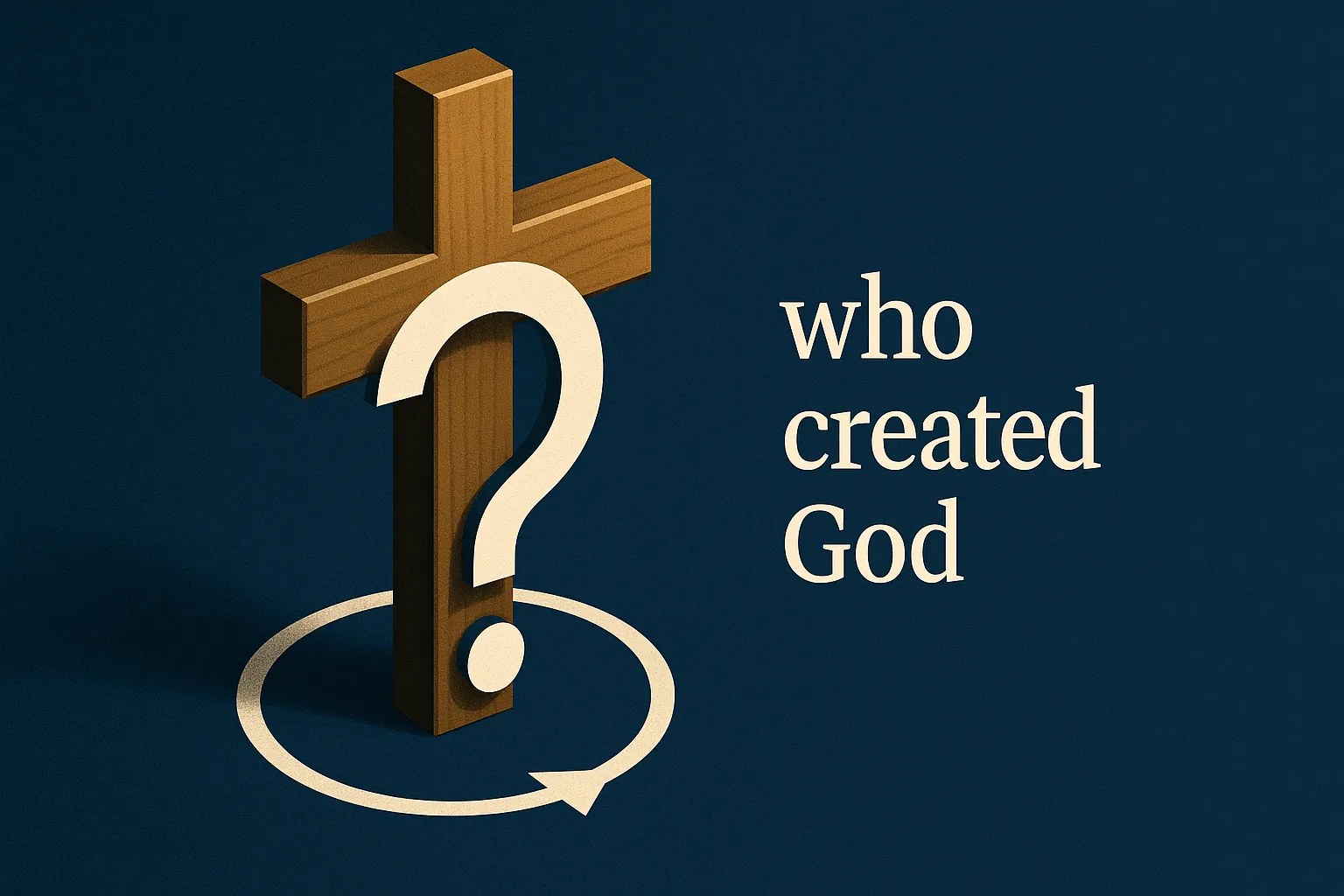
Who Created God? How to Answer the Question That Stumps Most Christians
On this pageKey takeawaysOn this pageWhy "who created God" is the wrong questionWhat the Bible actually says about God's originEternal in Hebrew and GreekKey verses to memorizeThe logical trap behind the question (and how to expose it)Exact phrases
Nothing created God. That's the short answer to who created God, and it isn't a dodge — it's the only answer that fits what the word God actually means in Christian theology. The question sounds devastating until you slow down and look at the assumption tucked inside it.
Here's the trap: the asker assumes God is one more item on the list of things that exist, like a planet or a person, just bigger. If that were true, the question would be fair. But Scripture and careful philosophy have always claimed something different — that God is the reason anything exists at all, not another thing inside the universe needing its own cause.
So when a skeptic, a curious teenager, or your own 2 a.m. brain asks who made God, you don't need to flinch. You need a clear reason, a verse or two you actually know, and a sentence you've said out loud before. That's what's below.
Key Takeaways
- Nothing created God — the question assumes God is a created thing, which contradicts what the word God means in Christian theology.
- The causal premise is everything that begins to exist has a cause, not everything that exists has a cause — God never began, so the rule doesn't apply.
- Scripture states this directly: Psalm 90:2 calls God eternal from everlasting to everlasting, and Exodus 3:14 grounds His name in self-existent being (I AM).
- For a child, swap abstractions for an image: God isn't a thing inside the universe — He's the reason there's a universe at all.
- Knowing the verses cold matters more than winning the debate, which is one of the real reasons for studying the Bible instead of just quoting it.
Why "who created God" is the wrong question
The question contains a category error. It treats God as a created thing, then demands to know who created the created thing. That's like asking what's north of the North Pole, or what color a number is. The grammar works. The meaning doesn't.
Notice the hidden premise: everything that exists has a cause. No serious theist or philosopher claims that. The actual premise — the one used in classical arguments for God — is narrower: everything that begins to exist has a cause. God, by definition, did not begin. So the rule doesn't apply to Him, not because we're cheating, but because the rule was never about Him in the first place.
Another analogy. Ask a bachelor about his wife. He doesn't have one — not because he's hiding her, but because "bachelor" already means "unmarried man." Ask who created the uncreated, and you get the same kind of silence. The question collapses on its own definition.
Try this the next time it comes up: pause and ask yourself what assumption the question is smuggling in. Almost every time, it's the assumption that God is a contingent being. He isn't, and you're allowed to say so.
What the Bible actually says about God's origin
Scripture is direct: God is eternal, self-existent, and uncreated. He has no beginning, no maker, no prior cause. He isn't the oldest thing in the universe — He's outside the category of "things in the universe" entirely.
A handful of passages carry most of the weight here. Memorize one and you'll have it on hand when you need it.
- Psalm 90:2 — "Before the mountains were brought forth... even from everlasting to everlasting, thou art God."
- Isaiah 43:10 — "Before me there was no God formed, neither shall there be after me."
- Revelation 1:8 — "I am Alpha and Omega, the beginning and the ending... which is, and which was, and which is to come, the Almighty."
- Exodus 3:14 — "I AM THAT I AM." God names Himself as pure being, not as a being among others.
- John 1:1–3 — "All things were made by him; and without him was not any thing made that was made." God is the maker, not among the made.

Eternal in Hebrew and Greek
The Hebrew word behind "everlasting" in Psalm 90 is olam — a term for unbounded, horizon-less time. The Greek equivalent in the New Testament is aionios, often translated "eternal" or "age-lasting." Neither word means "a really long time." Both push past time itself when they're applied to God's nature. You can study both terms, with every verse they appear in, on Selah.
Key verses to memorize
If you only commit one to memory, make it Exodus 3:14. It's the verse Jesus echoes in John 8:58 — "Before Abraham was, I am" — and it's the cleanest biblical statement of God's self-existence. Pick a verse from the list above and say it out loud three times this week. That's it. That's the assignment.
The logical trap behind the question (and how to expose it)
"Who created God" is usually a gotcha, not a sincere question. The move goes like this: if you say God created the universe, then to be consistent you must explain who created God. If you can't, you're special pleading — making an arbitrary exception for your favorite being.
It sounds tight. It isn't. Special pleading means inventing an exception with no principled reason. Christians have a principled reason, and it's been on the books for two thousand years: God is a different kind of being. Necessary, not contingent. Uncaused, not caused. The exception isn't arbitrary — it's built into the definition of what "God" means.
Put the reasoning in plain English. Whatever begins to exist has a cause. The universe began to exist — Big Bang cosmology, cosmic background radiation, and the second law of thermodynamics all point to a finite past. Therefore the universe has a cause. God, by definition, didn't begin, so He doesn't need one. That's not a trick. That's the argument.
Turn the question around. Next time someone asks "who created God," repeat it back with one word changed: "Are you asking who caused the uncaused?" Watch what happens. Most people hear the contradiction the moment they're forced to say it out loud. You haven't insulted them — you've just handed them their own sentence.
The common follow-up: "Then why can't the universe just be eternal instead of God?" Because the physical evidence cuts against an eternal universe. Entropy increases, galaxies recede, background radiation cools — all signs of a finite past. God's eternality is a claim about the kind of being He is. The universe's finitude is a claim from physics. They aren't symmetric.
Exact phrases to use when someone asks you
Three audiences ask this question, and they each need a different answer. Memorize whichever version fits the people in your life. You'll botch it the first time you try it cold — that's fine. Say it out loud now so it's there when you need it.
For a skeptic
- "Nothing created God. The God Christians believe in isn't a created thing — He's the reason anything exists at all."
- "Asking who made Him is like asking what's north of the North Pole. The words form a sentence, but the question doesn't survive its own definitions."
- "If you want to push back, push back on whether such a being exists — that's the real conversation. Asking who made Him assumes He's the kind of thing that could have a maker, and that's the part we'd disagree on."
For a child
"God didn't have a beginning. Everything you can see — trees, stars, you, me — had a start. God is different. He's always been here, and that's why He can make everything else. He's not the biggest thing in the world. He's the reason there's a world."
For your own doubts
"My mind wants every effect to have a cause. That's good thinking — that's how I figure out everything else. But somewhere the chain has to stop at something that didn't need a cause, or nothing would exist at all. The Bible says that something is a Someone, and His name is I AM."
Ask before you argue. Before you answer, ask: "What do you mean by God in that question?" Half the time the conversation shifts immediately, because the asker hasn't actually defined the term they're attacking. You'll save twenty minutes and start somewhere honest.
Common mistakes Christians make when answering
Most of us blow this conversation in one of four ways. None of them are fatal. All of them are fixable once you've named them.
Mistake 1: getting defensive. The question isn't always an attack, and even when it is, defensiveness signals you don't have an answer. Treat it as a real question even when it's not. Calm tone, slow pace.
Mistake 2: quoting a verse and stopping. "The Bible says God is eternal" isn't an answer for someone who doesn't trust the Bible yet. Give the reasoning first — uncaused vs. caused, necessary vs. contingent — and bring the verse in as the source of the claim, not the proof of it.
Mistake 3: overreaching. Don't claim you can prove God's eternality with a syllogism. You can't. What you can show is that "who created God" doesn't disprove Him, because it misunderstands the claim. That's a much smaller and much more honest move.
Don't miss the person. Sometimes "who created God" means "I'm scared the universe is meaningless." Sometimes it means "my dad was a pastor and I'm angry." Answer the puzzle if that's what they want, but watch their eyes. If the question has weight behind it, the puzzle isn't the point. Ask them what made them start asking.
After your next conversation about God, replay it in your head and ask which of those four you slipped into. You probably hit at least one. Name it, and you'll catch yourself faster next time.
Why this matters — and what are the reasons for studying the Bible deeply
A question like "who created God" is exactly the kind of thing that exposes shallow Bible reading. If you've only ever skimmed, you'll fumble. If you've studied — even a little — you'll have somewhere to stand. So what are the reasons for studying the Bible carefully rather than just reading verses on a coffee mug? Three of them are obvious once a hard question shows up at your door.
First, you'll know what Scripture actually claims about God's nature instead of repeating slogans. "God is eternal" lands differently when you've read Psalm 90 in context, traced olam through the Old Testament, and noticed how Isaiah hammers the same point at Israel's lowest moment.
Second, you'll see how the people inside the Bible wrestled with God's otherness themselves. Moses asks for a name and gets "I AM." Job demands an audience and gets a whirlwind. Paul stares at the same mystery in Romans 11 and ends up writing a doxology. You're not the first person to find God's self-existence strange. You're in good company.
Third, you'll have language ready. The person who asks you about God at a wedding reception won't wait while you Google. The teenager in your small group won't accept a vague answer. Study now, while no one's asking, and you'll have sentences when someone is.
Study now, while no one's asking, and you'll have sentences when someone is.
This is where the way you study starts to matter. Looking up a verse on Bible Gateway gives you the text. Pulling a Strong's number on Blue Letter Bible gives you the word behind it. But the question "who created God" pulls on the verse, the Hebrew, the character speaking, the place it was spoken, and the wider biblical claim — all at once. That's the kind of study Selah is built for: every verse linked to the people, places, and original-language terms behind it, so Exodus 3:14 isn't just a line, it's Moses, Midian, Mount Horeb, the burning bush, and the Hebrew ehyeh asher ehyeh — together, in one place, free.
Here's the assignment: open Exodus 3 tonight. Look up the Hebrew behind "I AM." Read Moses' character profile alongside it. Sit with the strangeness of a God who names Himself as pure being. That's the kind of study that builds answers you can actually use the next time someone asks who made the Maker.
"Who created God" stops being a threat the moment you understand what the question is actually doing. It's not exposing a flaw in Christian belief. It's revealing a misunderstanding about what kind of being God is. Once you see that, you can answer kindly, clearly, and without flinching — whether the asker is a skeptic, a child, or the voice in your own head at 2 a.m.
Nobody created God. He's the one in whom everything else gets created. Learn the verses, rehearse the phrases, and the next conversation will go better than the last one.
Frequently asked questions
What's the best short answer to 'who created God'?
Nothing created God, because God didn't begin to exist. Only things with a starting point need a cause, and the God of the Bible is eternal — without beginning or end. The question assumes God is created; Scripture says He isn't.
Is 'God is eternal' just special pleading?
No. Special pleading is making an exception with no reason; classical theism gives a reason. The argument has always been that whatever begins needs a cause, and God, by definition, never began. That's a principled distinction, not a convenient escape hatch.
Which Bible verse most directly answers who created God?
Psalm 90:2 is the clearest: Before the mountains were brought forth, or ever thou hadst formed the earth and the world, even from everlasting to everlasting, thou art God. Exodus 3:14 (I AM THAT I AM) and Revelation 1:8 (the Alpha and the Omega) reinforce it. You can read all three in context on Selah.
How do I explain who created God to a child?
Try this: "God isn't a thing inside the world that someone had to make. God is the reason the world is here at all. Everything that has a birthday needed a maker — God doesn't have a birthday." Then read Psalm 90:2 together.
If God created everything, did He create Himself?
No, and He couldn't. To create yourself, you'd have to exist before you existed — which is nonsense. God didn't create Himself; He simply is, which is the point of the name He gives in Exodus 3:14.
Can God create another God?
No, because anything created has a beginning, and a being with a beginning isn't God by the classical definition. God can create powerful beings, but a created God is a contradiction in terms, like a square circle.
Study the questions skeptics actually askRead Psalm 90, Exodus 3, and John 1 in beautiful typography, with linked character profiles, original Hebrew and Greek, and Easton's and Smith's dictionaries — all free on Selah.Open the Bible reader →
Most teams see directional impressions lift within 4–6 weeks of consistent publishing, with clicks following 2–4 weeks behind.No. RankMind generates structure, internal links, and schema automatically — you focus on the angle and the proof.Import it, run the content-refresh agent, and ship the rewritten draft. Existing rankings usually improve rather than reset.
Comments
Be the first to comment.