Why Hope Is Not Wishful Thinking According to the Bible
Why Hope Is Not Wishful Thinking According to the Bible
Faith and hope are not the same thing. Most people use them interchangeably, and that confusion costs them exactly when they need both most. When your circumstances directly contradict what you believe God promised, you need to know which tool you are holding and what it is for.
The connection between faith & hope is tighter than most Bible studies show. They are not synonyms, and they are not parallel tracks running side by side. They work together in a specific sequence, and understanding that sequence is what keeps a person standing when everything visible argues against the promise.
Key Takeaways
- When you feel your faith wavering, go back to the specific promise, not the feeling. Find the verse, read it in its original context, and let the text do the anchoring work your emotions cannot.
- Treat hope as active, not passive. Write down one promise from Scripture that applies to your situation right now, and return to it every morning until the answer comes or the situation changes.
- If you are not sure whether you are holding faith or hope in a given moment, ask yourself: am I trusting in what God has done (faith), or am I expecting what God will do based on that track record (hope)? The answer tells you which muscle to exercise.
- Study the biblical figures who waited longest before the promise arrived. Abraham, Joseph, and Hannah all held hope through years of silence. Their stories are not inspirational decoration; they are case studies in how anchored expectation actually behaves under pressure.
- Use a study tool that shows you the original Greek or Hebrew behind words like elpis (hope) and pistis (faith). Seeing the word's full range of meaning in context changes how you read every verse that contains it.
On this pageBiblical Hope Has a Foundation Wishful Thinking Never DoesFaith and Hope Are Not the Same Thing, and the Difference MattersWhat Happens When Your Circumstances Contradict the PromiseHow Faith and Hope Strengthen Each Other Under PressureWhich One to Lean On First When Life Falls ApartWhere to Study Faith and Hope in Scripture Without Getting Lost
Biblical Hope Has a Foundation Wishful Thinking Never Does
Wishful thinking is desire without evidence. Biblical hope is expectation grounded in God's proven character. That distinction is not semantic. It changes how you hold a promise when the circumstances around you say it will never arrive.
The Greek word elpis, used throughout the New Testament for hope, carries the sense of confident expectation. Not vague longing. Not 'I hope it works out.' Confident expectation, the kind a contractor has when a signed contract sits on the table. The outcome is not yet in hand, but the basis for it is solid.
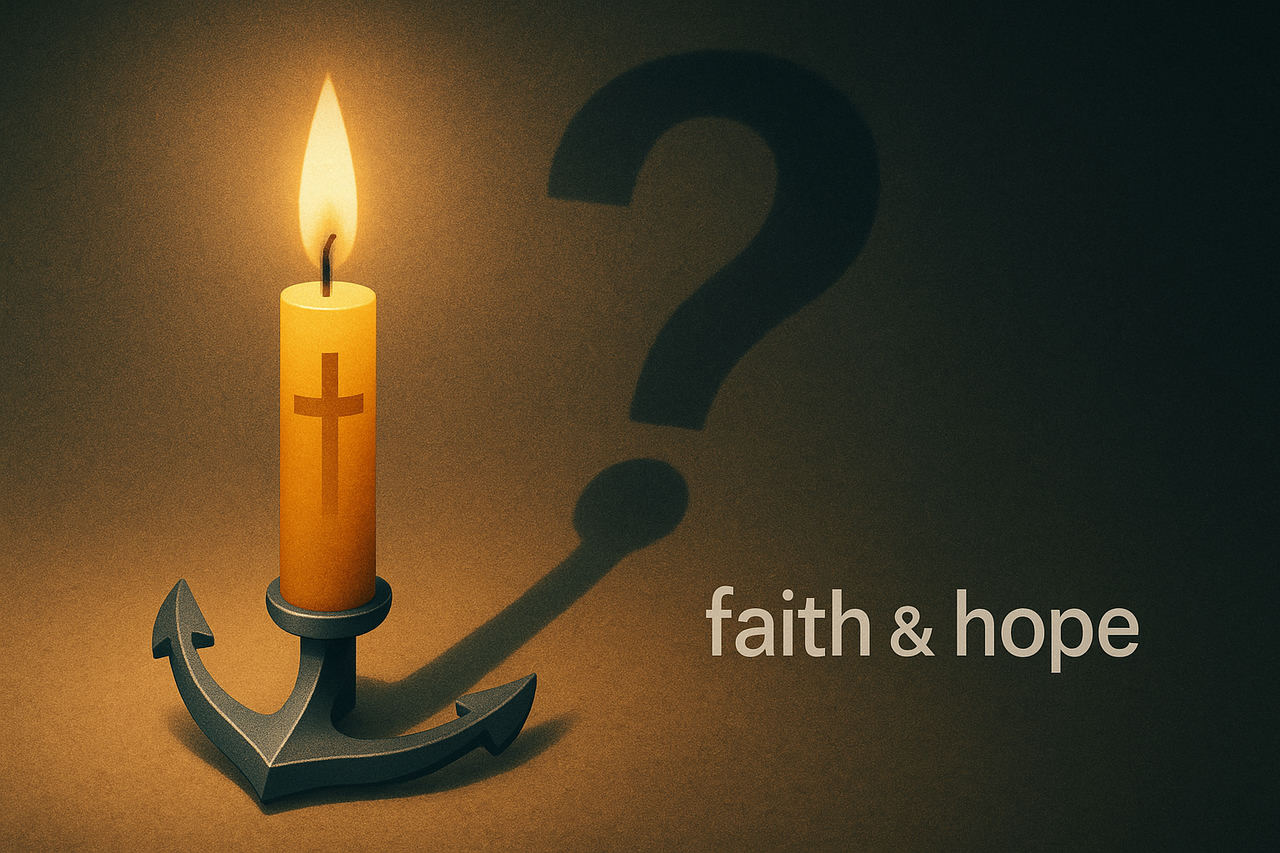
Hebrews 6:19 calls hope 'an anchor for the soul.' Anchors do not drift. They hold because they are attached to something fixed. That image only works if hope is attached to something real. Wishful thinking has no anchor point. Biblical hope is anchored to the character and promises of God, which have a track record.
Abraham is the clearest example. Romans 4:19 says his body was 'as good as dead' when God promised him a son. He was not optimistic. He was not ignoring the facts. He was trusting a specific promise from a specific God who had already spoken. That is the difference between wishful thinking and biblical hope. One says 'I hope things get better.' The other says 'God has promised, and He has never broken one.' Read Romans 4 and notice how Paul grounds Abraham's hope entirely in God's faithfulness, not Abraham's circumstances.
Faith and Hope Are Not the Same Thing, and the Difference Matters
Hebrews 11:1 links faith and hope directly: 'faith is the substance of things hoped for.' That phrasing is precise. Faith is the grip. Hope is what you are holding onto. They are not the same object.
Faith is the present-tense act of trusting God right now. Hope is the forward-facing confidence that what He promised will arrive. You can have hope without yet seeing the outcome. Faith is what keeps you acting as if the promise is real while you wait for it.
Here is a practical way to feel the split. When you pray, faith is what moves your lips. You are trusting God in this moment, with this request. Hope is what keeps you returning to prayer when nothing changes for months. Faith acts. Hope sustains the direction of that action over time.
Three distinct gifts, not three words for one. 1 Corinthians 13:13 lists faith, hope, and love as three separate things that endure. Paul does not treat them as synonyms. Each does a different job. Collapsing faith and hope into one word is not just imprecise — it leaves you without a tool when you need it most.
Knowing the difference also protects you from a common mistake: treating a season of thin faith as the end of hope. Faith can feel weak in a hard week. Hope, grounded in God's character rather than your feelings, can hold even then. They cover each other's gaps. Read Hebrews 11:1-6 this week and mark every place the text distinguishes what faith does from what hope points toward.
What Happens When Your Circumstances Contradict the Promise
This is the real test. God promised healing, provision, or restoration. The opposite seems to be happening. The gap between the promise and what you see is not evidence that God failed. It is the exact space where biblical hope does its work.
Romans 4:18 says Abraham 'against hope, believed in hope.' He held the promise when every visible fact argued against it. His body, Sarah's body, the years already gone. None of it moved him off the promise. That phrase 'against hope, believed in hope' is one of the most compressed descriptions of the Christian life in all of Scripture. It names the contradiction and then names the response.
The Psalms of lament show the same posture. Psalm 22 opens with 'My God, my God, why have you forsaken me?' and ends with praise. Psalm 88 is darker still, ending without resolution. These are not failures of faith. They are believers naming the contradiction out loud to God, honestly, without pretending it away and without abandoning hope. Lament is not the opposite of faith. It is faith talking to God about the gap.
Name both sides of the gap. Write down the specific promise you are holding from Scripture. Then write down what you currently see. Put both on paper. Naming both honestly is not doubt. It is the posture of biblical hope. You are not ignoring reality. You are placing reality next to the promise and choosing which one gets the final word.
If you are not sure which promises apply to your situation, a Bible topics page that organizes verses by theme (healing, provision, restoration, peace) can surface the right passages quickly. Selah organizes Scripture exactly this way, with verse collections grouped by topic so you can find the promise you need without reading through every concordance entry.
How Faith and Hope Strengthen Each Other Under Pressure
Faith and hope feed each other in a specific sequence under stress. When circumstances crush hope, faith recalls what God has already done. Past faithfulness becomes fuel for present trust. When faith feels thin, hope pulls the eyes forward to the promise still coming. It gives faith a target to aim at.
Romans 5:3-4 traces the chain plainly: suffering produces perseverance, perseverance produces character, character produces hope. Hope is built through the hard thing, not despite it. That sequence means the moment you feel most hopeless is often the moment hope is being formed in you, not the moment it has failed you. The pressure is doing something.
This is why the biblical hope is not wishful thinking meaning matters so much in a crisis. Wishful thinking collapses under pressure because it has no root. Biblical hope, grounded in God's character and the track record of His faithfulness, actually grows under the conditions that would destroy optimism. Optimism needs good news to survive. Hope does not.
Trace the Romans 5 chain in your own history. Write down one hard season you have already come through. Note what it produced in you. That record is not just personal history. It is evidence that the chain works, and it feeds both your faith and your hope for the current season.
Which One to Lean On First When Life Falls Apart
In acute crisis, the diagnosis, the phone call, the sudden loss, faith is the first tool. It is the act of saying 'God, I trust You' before you can see anything. You do not need a full theology in that moment. You need the grip.
Hope comes in as the crisis settles into a long wait. It is what sustains you across weeks and months when faith needs a direction to face. Practically: in the first hours, pray short prayers of raw trust. In the long weeks, return to specific promises in Scripture. Faith gets you through the night. Hope gets you through the year.
Hebrews 10:23 says 'hold fast the confession of hope without wavering, for He who promised is faithful.' Notice the reason given for holding hope is not your feelings or your circumstances. It is God's faithfulness. You are not manufacturing confidence from nothing. You are pointing to a record.
You do not have to produce either faith or hope by willpower. Both grow by returning to Scripture, to the character of God, and to the record of what He has done. If your hope feels thin right now, the next step is not to try harder. It is to read. Pick one promise and sit with it today.
Where to Study Faith and Hope in Scripture Without Getting Lost
The clearest single passage on hope as anchor is Hebrews 6:17-19. The clearest on faith is Hebrews 11:1-6. Read them side by side in one sitting. The contrast and the connection will be visible immediately.
Romans 4, 5, and 8 form a three-chapter arc on how faith and hope operate when circumstances are against you. Romans 4 gives you Abraham. Romans 5 gives you the suffering-to-hope chain. Romans 8 gives you the Spirit's role when you do not know how to pray. That stretch of Scripture is arguably the most practical on this topic in the entire Bible.
The Psalms of lament, particularly Psalms 22, 42, and 88, show what hope looks like when it is honest and struggling rather than polished. They are useful exactly because they do not resolve neatly. They model the posture of holding a promise while naming the pain.
For word-level study, an interlinear Bible maps every word to its original Hebrew or Greek without requiring seminary training. Tracing elpis (hope) and pistis (faith) through the New Testament yourself, seeing where each word appears and how it is used, is more clarifying than reading a dozen articles about the difference. Selah provides a free Strong's interlinear reader, an 8,000-term Bible dictionary combining Easton's and Smith's, and Matthew Henry's Complete Commentary, all without a paywall. You can look up elpis in the dictionary, trace it through the interlinear, and read Henry's notes on Hebrews 11 in one session.
Faith and hope are not feelings to be worked up. They are responses to what God has actually said and actually done. The more clearly you see His character in Scripture, the more naturally both take root. Start with Hebrews 6:17-19 today. Read it slowly. Let the anchor image do its work.
Frequently asked questions
Is hope a feeling or a choice according to the Bible?
Biblical hope is a choice grounded in evidence, not a feeling that arrives on its own. Romans 15:13 describes God filling believers with hope, which implies it is received and held actively, not simply felt. You can choose to anchor your expectation to God's character even on days when the feeling of hope is completely absent.
What is the difference between faith and hope in Hebrews 11:1?
Hebrews 11:1 defines faith as the substance of things hoped for, which means faith is the present-tense reality that gives hope its foundation. Hope looks forward to what is not yet visible; faith is the confident grip on the promise that makes that forward look possible. They are sequential: hope sets the direction, faith provides the footing. A fuller breakdown of the Greek terms behind both words is available at GotQuestions.
Can you have biblical hope when you feel completely hopeless?
Yes, and the Bible treats that tension honestly. Lamentations 3 opens with raw despair and lands on 'yet I will hope in him' inside the same chapter. The writer does not resolve the pain before choosing hope; he chooses hope in the middle of it. Biblical hope does not require the feeling of hope as a prerequisite.
Does the Bible say it is okay to doubt while still holding onto hope?
Doubt and hope are not opposites in Scripture. Thomas doubted and was not dismissed; the Psalms are full of writers who questioned God openly and still declared trust by the end. What the Bible warns against is not doubt but despair, which is the decision to stop expecting anything from God at all. Honest doubt asked in God's direction is different from abandoning the anchor entirely.
How do I hold onto hope when a specific prayer has gone unanswered for years?
The most practical step is to separate the timeline from the promise. God's silence on your schedule is not the same as a broken promise. Study the gap between God's word to Joseph and its fulfillment: roughly 13 years passed between the dream and the throne. Reading those accounts in full, with the original-language detail and character profiles available on Selah, shows you what sustained hope actually looked like in a real person's life across a long wait.
Study Faith and Hope in the Original LanguagesSelah gives you free access to the Strong's interlinear reader, 272+ biblical character profiles, and Matthew Henry's commentary so you can trace every verse on faith and hope back to its Hebrew or Greek root and see how real biblical figures lived both.Start studying free →
Comments
Be the first to comment.