Why the Bible Contains Books That Almost Made It In
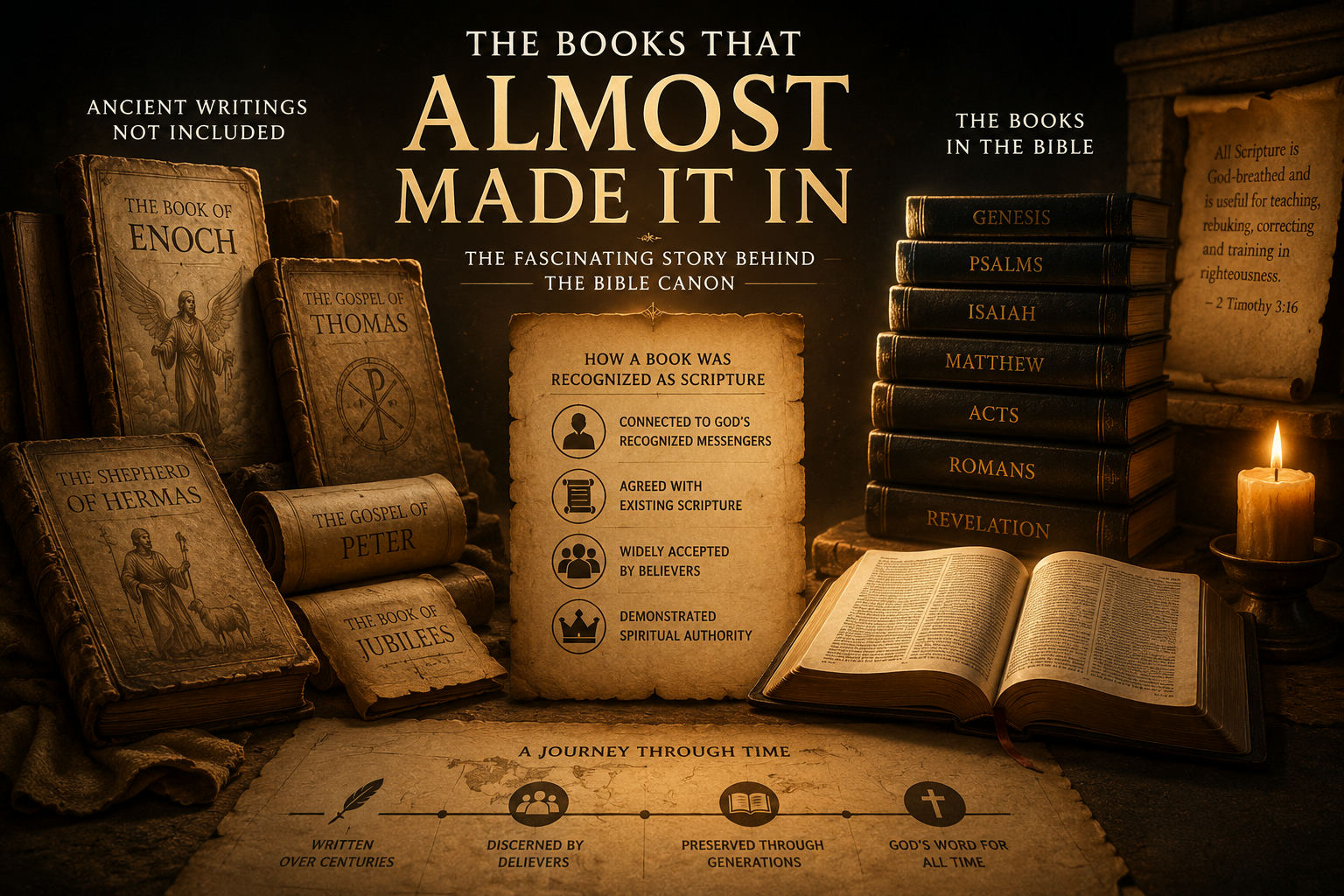
The fascinating story behind the books that were left out of the Bible
Most Christians know the Bible contains 66 books. What many don't realize is that throughout history, there were other ancient writings that some people believed should be included as well.
This raises an interesting question:
Were books removed from the Bible, or were they never meant to be there in the first place?
The answer takes us on a journey through ancient history, early Christianity, and the careful process of preserving Scripture.
What Are the "Lost Books" of the Bible?
When people hear the phrase lost books of the Bible, they often imagine secret writings hidden away by powerful leaders.
The reality is less dramatic but far more interesting.
These books are ancient religious writings that were known by Jews, Christians, or both, but were not included in the final biblical canon. Some were respected and widely read. Others appeared much later and contained teachings that conflicted with established Scripture.
Examples include:
The Book of Enoch
The Gospel of Thomas
The Shepherd of Hermas
The Gospel of Peter
The Book of Jubilees
Many of these texts still exist today and can be studied by historians and theologians.
How Did a Book Become Part of the Bible?
The Bible did not appear overnight.
The books were written over many centuries, and communities of believers carefully recognized which writings carried divine authority.
Several important questions guided this process:
Was it connected to God's recognized messengers?
For the Old Testament, this meant prophets recognized by Israel.
For the New Testament, this meant apostles or people closely connected to them.
Did it agree with existing Scripture?
A genuine book could not contradict truths that God had already revealed.
Consistency mattered.
Was it widely accepted by believers?
Books that were used and trusted across many churches carried greater credibility than writings known only in small groups.
Did it demonstrate spiritual authority?
Believers often recognized a unique quality in inspired Scripture that distinguished it from ordinary religious literature.
The Curious Case of the Book of Enoch
One of the most debated ancient books is the Book of Enoch.
It contains visions, angels, prophecies, and descriptions of heavenly events. What's especially surprising is that the New Testament letter of Jude directly references a prophecy attributed to Enoch.
This causes many readers to ask:
If Jude quoted Enoch, why isn't the book in the Bible?
The answer is that quoting a source does not automatically make the entire source Scripture.
The Apostle Paul quoted Greek poets on several occasions, yet their writings were never considered biblical books.
The Book of Enoch was influential and respected by some early believers, but it was not universally recognized as inspired Scripture.
The Gospel of Thomas and Other Early Writings
The Gospel of Thomas gained significant attention in modern times after the discovery of ancient manuscripts in Egypt.
Unlike the four Gospels, it mainly consists of sayings attributed to Jesus rather than a narrative of His life, death, and resurrection.
Many scholars believe it was written later than the New Testament Gospels.
Its teachings often reflect ideas associated with Gnosticism, a movement that taught secret spiritual knowledge as the path to salvation.
Because these teachings differed from the message found throughout the New Testament, early Christians did not accept the book as authoritative Scripture.
Were Books Removed From the Bible?
One of the most common myths is that church leaders removed books from the Bible to hide information.
Historical evidence points in a different direction.
Most disputed books were never universally accepted in the first place.
Rather than removing books that belonged, early believers were identifying which writings genuinely carried apostolic and prophetic authority.
The process was more about recognition than rejection.
What This Means for Christians Today
The existence of ancient religious books does not weaken the Bible.
In many ways, it highlights how carefully Scripture was preserved.
The fact that believers debated, examined, compared, and tested writings before recognizing them demonstrates the seriousness with which they approached God's Word.
Ancient texts like Enoch, Jubilees, and Thomas remain valuable historical resources. They help us understand the religious world surrounding the Bible and the questions people were asking at the time.
Yet Christians continue to view the biblical books as unique because of their consistent message, historical reliability, and enduring spiritual influence.
Final Thought
The story of the books that almost made it into the Bible reminds us that history is often more fascinating than myths.
Behind every page of Scripture lies a centuries-long process of preservation, discernment, and faith.
And perhaps the most remarkable fact is this:
Despite being written by dozens of authors across centuries and continents, the books that became the Bible tell one unified story of God's relationship with humanity.
That unity remains one of the most extraordinary features of the Bible today.
Comments
Be the first to comment.