Expository vs Topical Sermons: Which Approach Is Better
Expository vs Topical Sermons: Which Approach Is Better
Most guides on how to prepare sermon treat expository and topical preaching as the same task with the same steps. They are not. Choosing the wrong workflow before you open your Bible can cost you four or five hours of prep time and leave you with a sermon that feels forced. Pick the right method first, and the rest of the work gets cleaner.
This is a practical guide for the pastor or lay preacher who wants a concrete workflow, not a theology lecture. You will learn the real difference between the two methods, how to choose between them, and how to build your first sermon from scratch using free tools that do not require a seminary library.
Key Takeaways
- Before you open your Bible next week, decide which direction you are traveling: text to topic (expository) or topic to text (topical). That single decision shapes every hour of prep that follows.
- If you are preaching expository, read the passage in at least two translations and look up every key word in a Hebrew or Greek concordance before you write a single outline point. Selah gives you a free Strong's interlinear reader to do exactly that.
- If you are preaching topical, write your main question down before you search for verses, then require every verse you use to answer that specific question in its original context. This one discipline cuts proof-texting by half.
- Keep a running sermon file, not just a folder of notes. Log the passage, the big idea, the method you used, and what landed with your congregation. Patterns in that file will sharpen your prep faster than any course.
- When your prep feels stuck, go back to the text and ask one question: what problem does this passage solve for the original audience? The answer almost always hands you your sermon's main point.
On this pageThe Real Difference Between Expository and Topical SermonsHow to Know Which Method Fits Your Text and CongregationThe Expository Sermon Prep Workflow, Step by StepThe Topical Sermon Prep Workflow, Step by StepThe Preparation Mistakes That Cost Preachers the Most TimeA Concrete First-Sermon Plan You Can Start TodayExpository vs Topical: A Side-by-Side Comparison
The Real Difference Between Expository and Topical Sermons
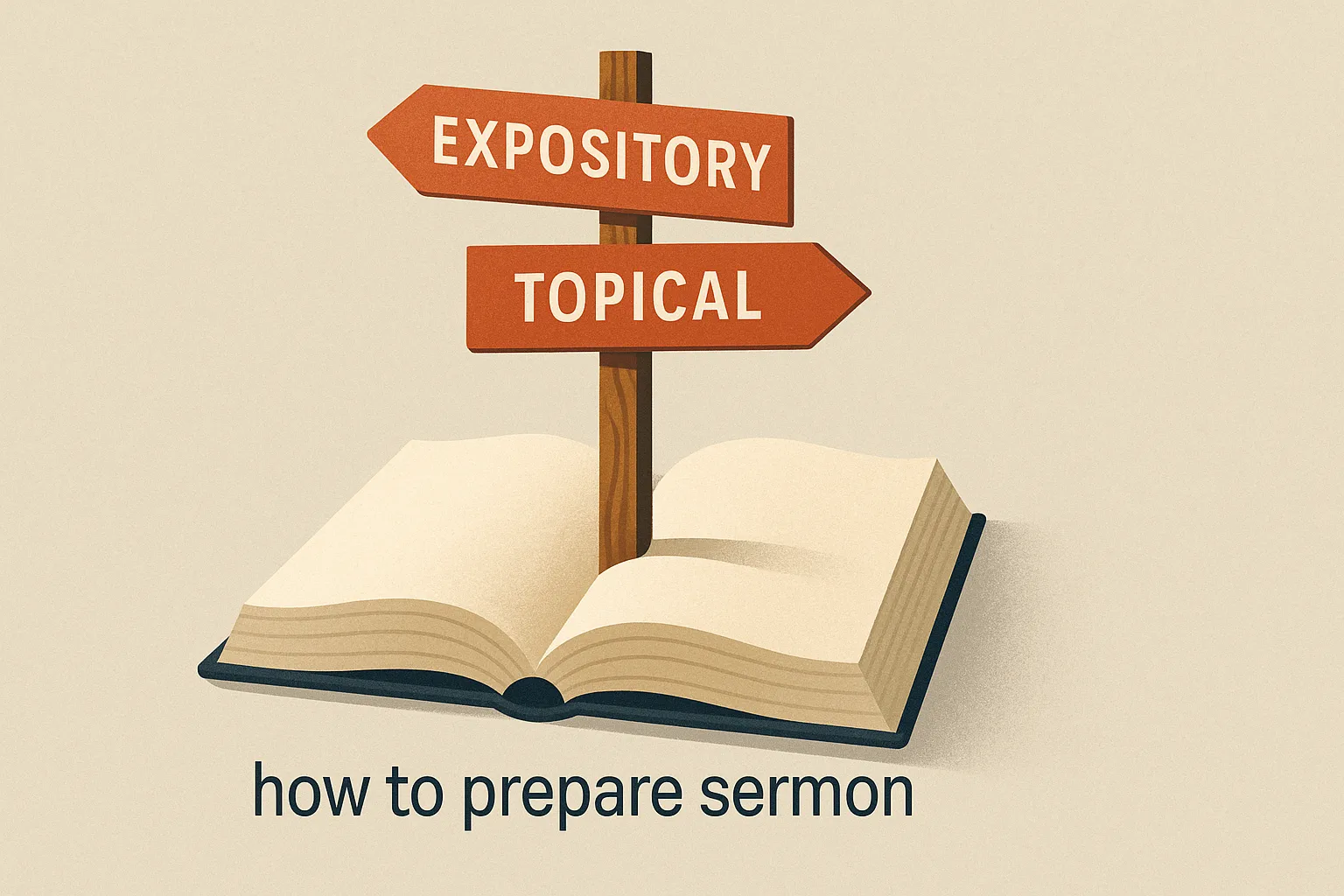
Expository preaching works through a specific passage verse by verse. The text sets the agenda. The subject comes from the passage, not from you. Topical preaching starts with a subject and gathers supporting verses from across Scripture to address it. The direction of travel is the whole difference: expository moves from text to topic, topical moves from topic to text.
Here is a quick test. If you already know your subject before you open your Bible, you are doing topical prep. If the passage hands you the subject after you read it carefully, you are doing expository prep. Most generic prep guides skip this distinction entirely and give you the same six steps for both methods. That is why preachers end up forcing a topical outline onto an expository passage and wondering why it feels flat.
Neither method is spiritually superior. Expository preaching is not more faithful just because it stays in one passage. Topical preaching is not shallow just because it ranges across Scripture. What matters is that each method demands a completely different first move. Get that first move wrong and every hour after it is harder than it needs to be.
Start by deciding which direction you are traveling before you write a single note.
How to Know Which Method Fits Your Text and Congregation
Expository preaching works best when a passage has a single, sustained argument. Romans 8, the Sermon on the Mount, a whole psalm. These texts carry their own logic from start to finish. Your congregation benefits most from expository preaching when they need to grow in biblical literacy, when they are unfamiliar with how a book of the Bible holds together.
Topical preaching works best when your congregation faces a specific, felt need: grief, fear, a marriage in crisis. It also fits church seasons like Advent, when a theme naturally spans multiple texts across weeks. The subject is real and urgent, and you need Scripture to speak directly to it from several angles.
Narrative passages are a special case. Ruth, the prodigal son, the life of Joseph. These texts are usually better handled as expository or narrative sermons. Pulling three verses out of a story for a topical point strips the narrative of its power. The story is the argument. Let it run.
If you are preaching a series, expository keeps you accountable to the text week after week. Topical series require extra discipline to avoid cherry-picking verses that only seem to support your point. Ask two questions before you start: What does this passage demand? What does this congregation need right now? Where those answers overlap is your method.
The Expository Sermon Prep Workflow, Step by Step
Step 1: Observe the Text Before You Consult Anything Else
Read the passage at least three times in different translations before you open any commentary. This is not optional. Commentaries are written by brilliant people who have already done their thinking. If you read them first, you will preach their sermon, not yours. Read slowly. Note every repeated word, every contrast, every question the text raises in your mind.
Step 2: Find the One Big Idea the Passage Is Making
State the passage's main claim in one sentence of 15 words or fewer. If you cannot do this, you do not yet understand the text well enough to preach it. This single sentence is the spine of your sermon. Everything else, every illustration, every application, every transition, should serve it.
Word study helps here. English translations sometimes soften a word choice that the original Hebrew or Greek makes sharp. Strong's numbers and an interlinear reader (which shows the original language word-for-word beneath the English) let you catch those moments without knowing the languages fluently. Selah gives you free access to the Hebrew and Greek behind every verse, along with Matthew Henry's commentary and cross-references via the Treasury of Scripture Knowledge, all without a paid subscription.
Step 3: Build Your Outline From the Text's Own Structure
Use the passage's structure as your outline skeleton. A three-stanza psalm gives you three points. A cause-and-effect argument in Paul gives you two. A narrative with a turning point gives you a before, a crisis, and an after. You are not imposing a structure; you are tracing the one already there. Character profiles for any biblical figure in the passage are free on Selah and can fill in background that shapes how you explain the text to your congregation.
The Topical Sermon Prep Workflow, Step by Step
Step 1: Define Your Topic With Surgical Precision
Write your topic as a question, not a word. Not "faith" but "What does faith look like when circumstances do not change?" The question keeps you from drifting. A single word like "hope" or "forgiveness" can mean forty different things. A precise question has one answer, and that answer becomes your sermon.
Step 2: Gather and Filter Your Verses
Gather every verse that speaks to your question. A Bible topics page or concordance search is faster than memory alone. Selah's topics pages collect thematic verse sets and link related dictionary entries in one view, which saves real time at this stage. Then filter ruthlessly. Keep only the verses that directly answer your question in their original context. A verse pulled from its context is not support; it is decoration.
Step 3: Choose One Anchor Passage
Pick one anchor passage, usually four to ten verses, that carries the full weight of your argument. The other verses you gathered illustrate or confirm the anchor. They do not replace it. Build your outline around the answer to your question, not around the list of verses you collected. The list is research. The anchor is the sermon.
The Preparation Mistakes That Cost Preachers the Most Time
The most expensive mistake is applying expository steps to a topical sermon. Spending hours doing verse-by-verse grammatical analysis on five scattered proof texts is the wrong tool for the job. You needed one strong anchor passage, not five dissected fragments.
The mirror mistake is applying topical steps to an expository sermon: deciding your three points before you study the passage, then bending the text to fit them. The congregation can usually feel when the text is being bent. It sounds like the preacher is arguing with the passage instead of explaining it.
Skip this and preach two sermons. Preachers who cannot state their sermon's main point in one sentence before Saturday night almost always preach two sermons at once. The congregation follows neither. Write the sentence before you build the outline, not after.
Over-illustrating is a signal, not a solution. Adding three stories to make a point land usually means the point itself is not yet clear. Sharpen the point first. The illustration will find its place naturally.
Finally, do not leave application until the end of prep. Application should shape the outline from the start. Ask "So what?" at every step, not just at the end. A sermon that answers "So what?" throughout is far easier to follow than one that saves all the application for the last five minutes.
A Concrete First-Sermon Plan You Can Start Today
Pick one passage of six to twelve verses OR one specific question your congregation is asking. Do not try to do both on your first attempt. Combining methods before you are comfortable with either one produces confusion, not depth.
If you chose a passage, follow the expository workflow: read it three times in different translations, find the main claim in one sentence, then let the text's own structure build your outline. If you chose a question, follow the topical workflow: write the question precisely, gather and filter verses, pick one anchor passage, and build your outline around the answer.
For word study and commentary work, you do not need a paid library. Selah's interlinear reader, Easton's and Smith's combined dictionary (over 8,000 terms), and Matthew Henry's Complete Commentary are all free to browse without an account. Resources like Servant Called to Teach and Divine Sermons also offer solid first-sermon guidance for new preachers.
Write your single-sentence main point at the top of your notes page. Do not move on until it is clear. Every illustration, every application, and every transition you write after that should serve that one sentence. If a piece of content does not serve it, cut it.
Expository vs Topical: A Side-by-Side Comparison
Side-by-sideFactor · Expository · TopicalStarting point · The passage · The subject or questionStructure source · The text's own logic · Your argument's logicBest use · Sustained biblical literacy · Immediate congregational needMain risk · Losing congregation in details · Proof-texting or shallow exegesisFirst move in prep · Read and observe the passage · Write the question preciselyAnchor requirement · The passage itself · One chosen anchor passage
Both methods share the same destination: a clear main point, honest handling of Scripture, and an application the congregation can act on. The method you choose changes your first hour of prep completely. Everything after the outline converges toward the same goal.
Know both methods, use each deliberately. A preacher who can do both expository and topical prep, and knows when to use each, is more useful to a congregation than one who defaults to the same method every week. Practice each method on a short passage or question before you need it on Sunday.
The expository vs topical sermon preparation differences come down to one question: where does your sermon start? Answer that before you do anything else, and the rest of the workflow follows naturally. Your congregation does not need a perfect sermon. They need a clear one, built honestly from the text or the question in front of you.
Frequently asked questions
Is expository preaching harder to prepare than topical preaching?
Expository prep is more demanding up front because the passage controls your structure, and you cannot skip the original-language work without missing the point. Topical prep can feel faster at first, but finding verses that genuinely support your subject in context takes more discipline than it looks. Neither method is easier overall; they just place the hard work at different stages.
Can you combine expository and topical approaches in the same sermon?
Yes, and many experienced preachers do. A common hybrid is to anchor the sermon in one primary passage (expository) while pulling in two or three supporting verses from elsewhere in Scripture (topical). The key is that the primary passage still sets the main idea; the supporting verses illustrate or confirm it rather than redirect it.
How do you prepare a topical sermon without proof-texting?
Proof-texting happens when you choose a verse for its wording rather than its meaning. To avoid it, read every candidate verse in its full chapter context and ask what the original author was addressing. If the verse answers your sermon question in context, keep it. If it only sounds relevant when read in isolation, cut it.
What is the difference between a sermon outline and sermon notes?
A sermon outline is the skeleton: your big idea, two or three main points, and the transitions between them, usually fitting on one page. Sermon notes are the full manuscript or detailed bullet points you use to fill in that skeleton during delivery. Build the outline first and treat it as fixed; your notes can expand or contract around it as you rehearse.
What is the best free Bible study tool for sermon preparation?
Selah covers the core needs without a paywall: a full Bible reader with multiple translations, a Strong's interlinear for Hebrew and Greek word study, Matthew Henry's Complete Commentary, cross-references via the Treasury of Scripture Knowledge, and 272+ biblical character profiles. For most sermon prep workflows, that combination replaces tools that normally cost a monthly subscription.
How many hours should sermon preparation realistically take each week?
Most working pastors report spending eight to twelve hours on a single sermon, with expository messages on the higher end when original-language study is included. First-time preachers often need more time simply because the workflow is unfamiliar. The hours drop significantly once you have a repeatable process and a reliable set of study tools you know how to use quickly.
Study the Text Before SundaySelah gives you a free Strong's interlinear reader, Matthew Henry's commentary, cross-references, and full character and place profiles — everything you need to move from passage to pulpit without a paid subscription.Start studying free →
Comments
Be the first to comment.