How to Fast Without It Becoming a Religious Performance
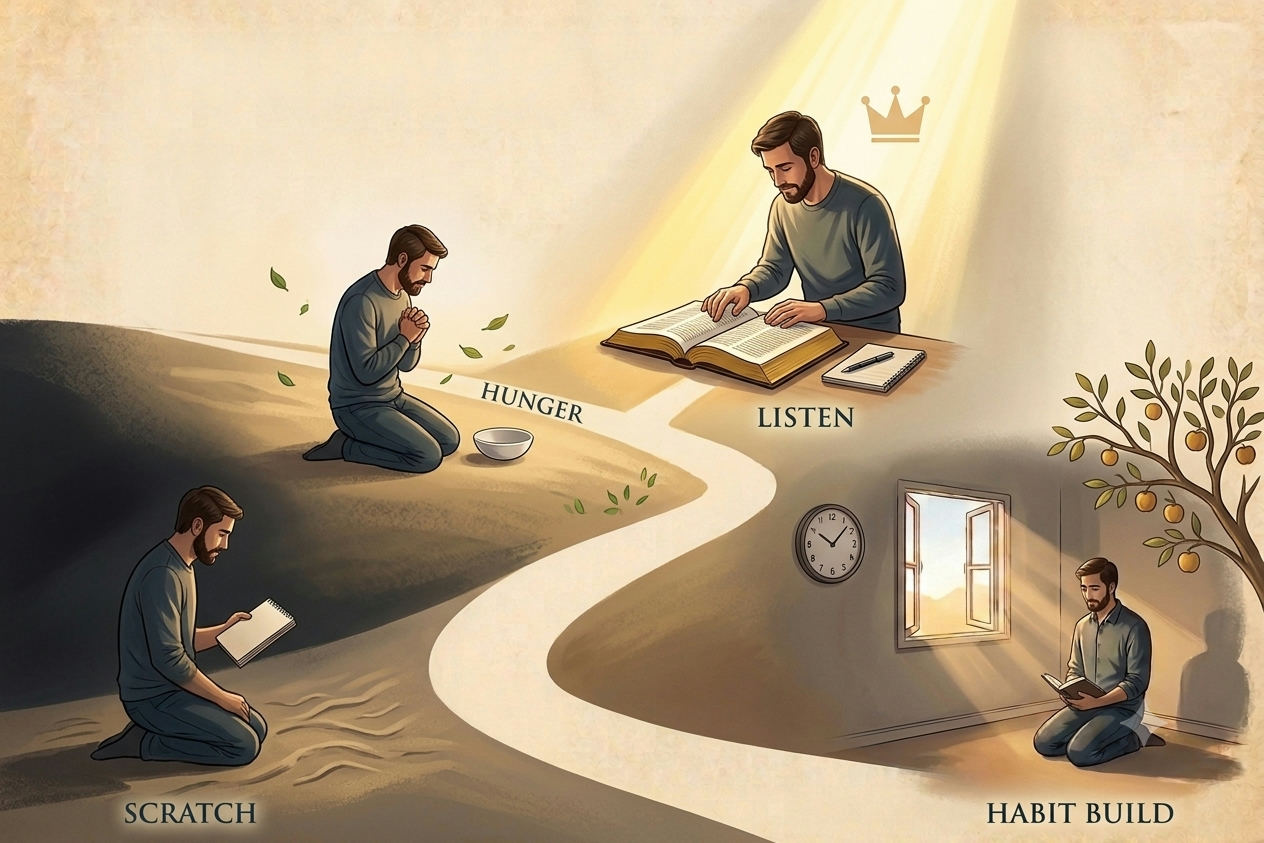
How to Fast Without It Becoming a Religious Performance
Most people who try prayer & fasting quit by day two. Not because they lack faith, but because no one told them how to structure it. They skip a meal, feel hungry and vaguely guilty, then wonder why God feels farther away than usual.
This is the part most articles skip: fasting without a plan is just hunger. And fasting performed for an audience is something Jesus explicitly warned against. What follows is a practical guide to doing it right — not as a spiritual achievement, but as a real tool for focused prayer.
Key Takeaways
- Before your next fast, write down one specific thing you want to bring to God — a decision, a burden, a person — so hunger becomes a prompt to pray toward something concrete rather than a vague spiritual exercise.
- Pick a fast length that matches where you are right now, not where you think you should be: one skipped meal is a legitimate starting point, and finishing a short fast with focus beats abandoning a long one out of pride.
- Read Matthew 6:16-18 before you begin and decide in advance who, if anyone, you will tell — making that choice ahead of time removes the temptation to perform or announce mid-fast.
- When you feel the urge to quit, pause and ask one honest question: am I stopping because my body genuinely needs care, or because I'm uncomfortable and looking for permission to stop? The answer usually comes quickly.
- Use the time you would have spent eating to open Scripture and pray through the passage — Selah has free Bible reading plans, topical verse collections, and Matthew Henry's commentary that can anchor your prayer when you don't know where to start.
On this pageWhat Prayer and Fasting Actually Does (and What It Doesn't)Pick the Right Type of Fast Before You StartHow to Structure Your Day So the Fast Becomes PrayerThe Signs Your Fast Is Sliding Into PerformanceHow to Break a Fast Without Losing What You GainedWhat to Do When Fasting Feels Like Nothing Is Happening
What Prayer and Fasting Actually Does (and What It Doesn't)
Prayer and fasting is the practice of voluntarily giving up food, and sometimes other things, to create space for focused dependence on God. Not to earn His attention. Not to impress Him. To reposition yourself so hunger becomes a prompt to pray instead of just an inconvenience to manage.
Jesus assumed His followers would fast. Matthew 6:16 says when you fast, not if you fast. But He spent more words warning against doing it for show than explaining the mechanics. That ratio is worth paying attention to.
Fasting does not twist God's arm. It changes your posture. When your stomach growls at noon, that physical signal can either send you to the fridge or send you to your knees. The fast trains you to choose the second option. That's the whole mechanism.
If nothing changes in how you relate to God during the fast, the skipped meals are just a diet. The internal work is the point. Start by asking yourself one honest question before you begin: what do I actually want to bring to God during this time?
Pick the Right Type of Fast Before You Start
There is no single biblical fasting template. Scripture records full fasts with no food or water, like Esther's three-day fast in Esther 4:16. It records partial fasts, like Daniel's plant-and-water fast in Daniel 1 and 10. And it records fasts from things other than food entirely. The variety is intentional.
Match the fast to your health, your schedule, and your actual goal. A new faster who skips straight to a 72-hour water-only fast is setting up for physical misery that crowds out prayer. Misery is not the same as devotion.
Two good starting points. A one-meal fast (skip lunch, use that hour to pray) or a sundown-to-sundown 24-hour fast. Both are short enough to finish and long enough to feel real. Either one will teach you more about your own distractibility than a week of reading about fasting.
The Daniel Fast, which limits you to vegetables, fruits, and water while cutting out meat and sweets, is a solid middle option for longer fasts. It keeps your blood sugar stable enough that you can actually think and pray clearly, rather than spending the afternoon fighting a headache.
Before you start, write down two things: what you are fasting from and how long you are committing to. Vague commitments collapse under hunger. A written decision made before the fast begins holds better than a mental note made when you're already hungry.
How to Structure Your Day So the Fast Becomes Prayer
Without a daily structure, a fast is just skipping meals. The hunger arrives, you have nothing to do with it, and you scroll your phone instead of praying. This is the gap that most prayer-list articles never address.
Replace each meal slot with a specific prayer block. If you normally eat breakfast at 7am, that 20 to 30 minutes becomes your prayer time. The hunger cue becomes your alarm. Same logic applies to lunch and dinner. You are not just removing food; you are replacing it with something.
Keep a short written focus for the fast. One question you're bringing to God. One person you're interceding for. One area of your life where you want clarity. Narrow is better than broad. A fast with five big topics usually ends up covering none of them well.
Use a Bible reading plan or a structured study tool during those blocks rather than free-form reading. Selah has nine reading plans and a full interlinear reader that lets you sit with the original Hebrew or Greek behind a passage when a verse stops you. That kind of depth is useful when you have 25 minutes and a specific question.
At the end of each prayer block, write two or three sentences about what you noticed. Not a journal essay. Just enough to track whether anything consistent is surfacing across the fast. Patterns across multiple prayer blocks are often where the real clarity lives.
The Signs Your Fast Is Sliding Into Performance
Jesus named the exact behavior to avoid in Matthew 6:16-18: fasting in a way that signals to other people that you are fasting. The Pharisees disfigured their faces so no one would miss it. The modern versions are subtler, but the same instinct is behind them.
- Mentioning your fast unprompted in conversation
- Posting about it on social media
- Feeling quietly superior to people who aren't fasting
- Tracking it like a spiritual achievement you can reference later
A useful gut-check: if the fast ended right now and no one ever knew you did it, would that bother you? If the answer is yes, that feeling is worth praying about before you continue. It doesn't disqualify the fast, but it's information.
Legalism shows up differently. It looks like treating the fast as a contract with God: I fast three days, You give me the answer I want. Or feeling genuine guilt if you break the fast early because of illness or a medical need. That guilt is not conviction; it's a category error. Fasting is a tool, not a vow.
Breaking a fast early for a real reason is not failure. If your body needs food, eat. You can reschedule. The goal was never to prove you could endure; it was to create space for prayer. If the fast is creating more anxiety than space, it has stopped serving its purpose.
How to Break a Fast Without Losing What You Gained
Breaking a fast physically is straightforward. After a 24-hour fast, start with broth, fruit, or something light before a full meal. After three or more days, give your digestive system a day or two to adjust before eating normally. Going straight to a heavy meal after an extended fast is a reliable way to feel terrible.
Breaking a fast spiritually is the part most people skip entirely. Before you eat, spend five minutes in prayer specifically closing the fast. Thank God for what you noticed. Name any clarity you received. If you didn't get the answer you wanted, release the outcome out loud. That act of release is itself a form of trust.
What you heard or sensed during those prayer blocks doesn't evaporate when you eat. Write it down and return to it over the next week. Distance from the fast often makes the pattern clearer, not murkier.
Resist the urge to immediately fill the freed-up time with entertainment or busyness. Give the quiet a few more days before your schedule snaps back to normal. The transition back is where a lot of the fast's value either settles in or gets lost.
What to Do When Fasting Feels Like Nothing Is Happening
Most fasts feel ordinary. You're hungry, you pray, nothing dramatic occurs. This is normal. It is not a sign the fast is failing.
Daniel prayed and fasted for 21 days before any response came (Daniel 10:2-13). The fast was not wasted during those three weeks. It was the posture he held while waiting. The waiting was part of the work.
Check what you're doing with the silence. If you feel nothing during a fast, ask whether you are presenting God with a list of demands or actually listening. Fasting creates space. What you do with that space is what determines whether the fast becomes prayer or just hunger management.
Try reading a Psalm slowly during one of your prayer blocks instead of speaking. Psalm 62, Psalm 27, and Psalm 139 are particularly useful when you feel distant from God. Read a verse, pause, sit with it. The Selah Bible reader lets you pull up cross-references and Matthew Henry's commentary on any verse so you can go deeper when one line lands and you want to stay there.
If a fast consistently produces anxiety, guilt, or obsessive thinking about food, stop. Fasting is meant to free your attention, not consume it. There is no spiritual credit for pushing through something that is harming you. Speak to a doctor or counselor if those patterns feel familiar outside of fasting too.
The question worth sitting with after any fast, whether it felt powerful or flat, is simple: did I show up? Consistency over time matters more than any single dramatic experience. A quiet fast where you showed up every prayer block and wrote three sentences is more useful than a dramatic one you abandoned on day two.
Frequently asked questions
How long should my first fast be if I've never fasted before?
Start with one meal, not one day. Skip lunch, use that hour to pray and read Scripture, then eat a normal dinner. Once you've done that two or three times without drama, a full 24-hour fast from dinner to dinner becomes a realistic next step.
Is it wrong to tell anyone you're fasting, or does Matthew 6 mean total secrecy?
Matthew 6 targets performance — fasting to be seen and admired. Telling a spouse so they don't plan a big meal, or asking a close friend to pray with you, is not the same thing. The test is motive: are you telling them because it serves the fast, or because you want credit for it?
What should I pray about during a fast if you don't have a specific need?
Use the fast to pray through a book of the Bible passage by passage, asking God what He wants you to see. You can also pray for people in your life by name, or use a topical verse collection — Selah's Bible topics pages organize Scripture by theme and link related characters and dictionary entries, which gives your prayer real content to work with.
Does the Daniel Fast count as a real fast if you're still eating?
Yes. Daniel 10:3 describes Daniel avoiding meat, wine, and rich food for three weeks while still eating — and Scripture treats it as a genuine fast with genuine results. The Daniel Fast is a partial fast, not a lesser fast. What matters is that you are voluntarily restricting something normal in order to create space for prayer.
How do I know if I broke my fast for a legitimate reason or just gave up?
Ask whether the reason existed before you started or appeared once the discomfort set in. A migraine that won't lift, a medical condition, or a genuine pastoral emergency are legitimate reasons to stop. Boredom, mild hunger, and a good smell from the kitchen are not. If you're unsure, eat something small, rest, and resume rather than declaring the fast over.
Can fasting from something other than food still be a biblical fast?
Scripture's primary model is food, but the principle is voluntary sacrifice of something normal to redirect attention toward God. Fasting from social media, entertainment, or a habit can carry the same spirit if the time you free up is genuinely given to prayer and Scripture. Just be honest with yourself: if giving up Netflix costs you nothing emotionally, it probably isn't functioning as a fast.
Study the Scripture behind your fastSelah gives you free access to the full Bible, Strong's interlinear, Matthew Henry's commentary, and topical verse collections — everything you need to anchor your prayer in what God has already said.Start studying free →
Comments
Be the first to comment.