What Is the Difference Between Faith and Hope in Scripture
What Is the Difference Between Faith and Hope in Scripture
Faith & hope appear together so often in the Bible that it's easy to treat them as the same word in different clothes. They are not. Each one does a specific job, and mixing them up leaves you reaching for the wrong tool when hardship arrives.
The difference between faith and hope in the Bible is not subtle once you see it. Faith is present-tense trust in who God is and what he has said. Hope is forward-facing expectation of what God will do. You need both. But they are not interchangeable, and the Bible is careful to keep them distinct.
Key Takeaways
- When you feel stuck in prayer, ask yourself which tool you are missing: if you doubt God's character or his word, that is a faith problem; if you cannot picture a future where God acts, that is a hope problem. Naming the gap helps you address it directly.
- Read Hebrews 11 as a case study in how faith and hope work together under pressure. Each figure in that chapter trusted God in the present (faith) while reaching toward a promise not yet fulfilled (hope). Let their stories shape how you read your own circumstances.
- The next time you catch yourself saying 'I hope God will...' pause and check whether that hope is anchored to something God has actually said in Scripture. If it is not, find the promise that applies and let that become the foundation your hope stands on.
- Use a free tool like Selah to look up every verse where faith and hope appear together, read the original Greek words (pistis for faith, elpis for hope), and see exactly what each word meant to the first readers. The interlinear reader makes that a ten-minute exercise, not a seminary project.
- When love feels hard to practice, remember Paul's logic in 1 Corinthians 13: love outlasts both faith and hope because it is not waiting for anything. Let that reframe how you treat the people in front of you today, not as a spiritual exercise, but as the end goal faith and hope are pointing toward.
On this pageFaith and Hope Are Not Synonyms: What Each One Actually DoesThe Hebrew and Greek Words Show the Difference More ClearlyWhich Comes First: How Faith and Hope Work in SequenceWhat Each One Does When You Face Real Doubt or HardshipWhy Paul Puts Hope Between Faith and Love in 1 Corinthians 13How to Spot Faith and Hope Separately in Any Bible PassageWhy Paul Links Faith, Hope, and Love as a Trio Across His Letters
Faith and Hope Are Not Synonyms: What Each One Actually Does
Hebrews 11:1 is the clearest starting point: 'Faith is the substance of things hoped for, the evidence of things not seen.' Notice what that verse does. It defines faith by pointing toward hope as its object. Faith is the grip. Hope is the direction you are gripping toward. They are partners, not duplicates.
Hope, by contrast, is always forward-facing. Romans 8:24-25 puts it plainly: 'Hope that is seen is not hope.' Hope always points to something not yet in hand. The moment you have it, hope shifts to gratitude, not more hoping.
The clearest proof they are distinct comes from 1 Corinthians 13:13, where Paul lists faith, hope, and love as three separate things. He does not say 'faith, which is also hope.' He counts them. You can have hope without strong faith, but that is closer to a wish than to biblical hope. Biblical hope without faith has no anchor. It is optimism, not expectation rooted in God's character.
A working distinction to keep handy. Faith answers: 'Can I trust God right now?' Hope answers: 'Is something good still coming?' Both questions matter. Both need a biblical answer. But they are different questions.
Read 1 Corinthians 13 in a translation you find clear, then count how many times Paul treats faith, hope, and love as three distinct capacities rather than one blurry virtue.
The Hebrew and Greek Words Show the Difference More Clearly
Translations smooth things over. The original words are more precise. In the Old Testament, the Hebrew word most often translated as faith is emunah (Strong's H530). It means firmness, steadiness, reliability. It describes a state of being, not a feeling. When the prophets call Israel to faithfulness, they are calling the people to be emunah: steady, not wavering.
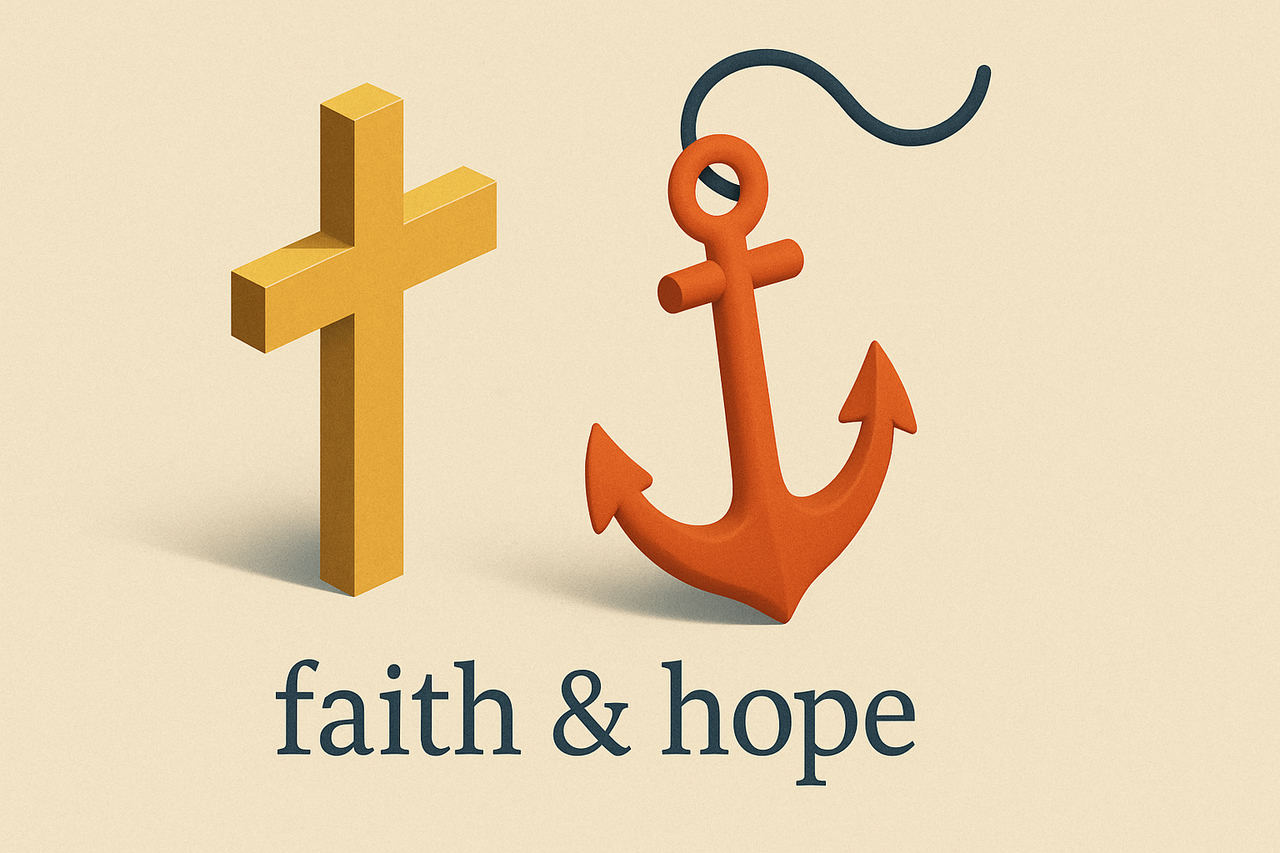
The Hebrew word for hope is tiqvah (Strong's H8615), and it literally means a cord or a thread stretched out. That image is not accidental. In Joshua 2:18, Rahab hangs a scarlet cord from her window as a sign of deliverance. The word for that cord shares the same root as tiqvah. Hope is the cord stretched toward a promise you cannot yet see fulfilled.
In the Greek New Testament, faith is pistis (Strong's G4102): active trust, confidence placed in a person. Hope is elpis (Strong's G1680): a confident expectation of something good that is coming. Pistis is a hand gripping a rope. Elpis is the rope stretching toward something you have not yet reached. Both are needed. Neither replaces the other.
You can look up every occurrence of pistis and elpis in their original context using the Strong's interlinear reader at Selah. Search a word, see every verse where it appears, and read the Hebrew or Greek alongside the English. The pattern becomes hard to miss once you see the word pictures side by side.
Which Comes First: How Faith and Hope Work in Sequence
Romans 5:1-5 gives the clearest biblical sequence. Justification by faith produces peace. Peace produces endurance through suffering. Endurance produces character. Character produces hope. Hope is downstream of faith, not upstream. Faith is the root; hope is the fruit that grows from a root that has been tested.
This means faith is the starting point. You trust God first. That trust, pressed by real circumstances, produces a specific, confident expectation. That expectation is hope. A person diagnosed with a serious illness who trusts that God is sovereign (faith) begins to expect that God will either heal or sustain them through it (hope). The trust comes before the expectation. You cannot reverse the order and get the same result.
Romans 5:1-5The biblical sequence: faith produces peace, peace produces endurance, endurance produces character, character produces hopeRomans 5:1-5 (ESV)
Romans 15:13 calls God 'the God of hope' and says he fills believers with joy and peace 'in believing.' The believing, which is faith, is what activates the hope. This also explains why hope can feel thin when faith is weak. Strengthen the root and the fruit follows. If your hope is running dry, the question to ask is not 'How do I hope more?' but 'Where has my trust in God grown shaky?'
Trace Romans 5:1-5 slowly this week. Write out the sequence in your own words and identify which step you are currently standing on.
What Each One Does When You Face Real Doubt or Hardship
When doubt hits, faith is the thing being tested. Hebrews 11 lists people who acted on what they trusted God had said. Noah built before rain fell. Abraham left before he knew where he was going. Faith is the response to what God has already spoken. It does not wait for visible evidence before it acts.
Hope is what keeps you moving when the outcome is still invisible. Romans 8:25 says 'if we hope for what we do not yet have, we wait for it patiently.' Hope is the posture of waiting without collapsing. It is not passive. It is active endurance aimed at a specific promise.
In grief or loss, faith answers: 'Is God still trustworthy?' Hope answers: 'Is there still something good ahead?' You need both, but they do different work. Psalm 42:5 shows this in real time: 'Why are you cast down, O my soul? Hope in God, for I shall again praise him.' The psalmist is not manufacturing faith from scratch. He is redirecting his expectation toward a God he already knows. The faith is the foundation; the hope is the redirection.
Two questions for hard seasons. If you feel stuck spiritually, identify which question you are actually wrestling with. 'Can I trust God?' is a faith question. 'Will anything change?' is a hope question. The answer to each comes from a different part of Scripture, and knowing which one you need keeps you from applying the wrong passage to the wrong problem.
Read Hebrews 11 in one sitting. For each person listed, identify what God had spoken (the faith object) and what they were waiting for (the hope object). The distinction becomes concrete fast.
Why Paul Puts Hope Between Faith and Love in 1 Corinthians 13
1 Corinthians 13:13 says 'the greatest of these is love.' That ranking implies faith and hope are below love, but the verse does not rank faith against hope. It ranks all three against eternity. In eternity, faith becomes sight and hope becomes possession. Love alone never becomes obsolete. It does not get replaced by something better; it simply continues.
Hope sits between faith and love in Paul's list because it is the bridge between them. Hope is born from faith and it sustains the kind of patient, self-giving love that 1 Corinthians 13 describes. You cannot love people well across long seasons of hardship without hope. Without hope, love collapses into duty, and duty runs out.
This is not a competition. Paul's point is that all three are essential now, and love outlasts the other two, not because faith and hope are weak, but because they are built for a world that still has distance between promise and fulfillment. When that distance closes, love is what remains.
Read 1 Corinthians 13 alongside Romans 5:1-5 and notice how hope appears in both as the thing that keeps love and faith from burning out under pressure.
How to Spot Faith and Hope Separately in Any Bible Passage
Look for the tense and the object. Faith statements tend to be present-tense and grounded in who God is or what he has already done. 'I know that my Redeemer lives' (Job 19:25) is a faith statement. Hope statements tend to be future-tense and grounded in what God will do. 'He will wipe every tear from their eyes' (Revelation 21:4) is a hope statement.
Watch for the word wait. Waiting language almost always signals hope, not faith. 'Those who wait for the Lord shall renew their strength' (Isaiah 40:31) is a hope verse, even though it requires faith to do the waiting. Watch for the word trust or believe. These almost always signal faith. 'Trust in the Lord with all your heart' (Proverbs 3:5) is a faith verse.
In the Psalms especially, you will often see both in the same breath. Psalm 31:14-15 says 'I trust in you, O Lord... my times are in your hand.' The trust is faith. The 'my times are in your hand' is hope: a forward-facing confidence that God holds what is coming.
Use the Bible topics pages at Selah to pull every verse tagged under faith or hope side by side. The pattern of tense and object becomes obvious quickly, and you will start catching it in passages you have read for years without noticing it.
Why Paul Links Faith, Hope, and Love as a Trio Across His Letters
Paul links faith, hope, and love as a set in at least five letters: Romans, 1 Corinthians, Galatians, Ephesians, and 1 Thessalonians. This is not a rhetorical habit. It reflects how Paul understood the Christian life to work as a whole.
Faith is the foundation: you receive God's grace through it. Hope is the orientation: it keeps your eyes on what God has promised. Love is the expression: it is how faith and hope show up in how you treat people. Colossians 1:4-5 ties all three together in one sentence. Paul thanks God for the Colossians' faith in Christ, their love for all the saints, and the hope stored up for them in heaven. The hope, he says, is what motivates the love.
Christian tradition sometimes calls the three the 'theological virtues,' virtues because they are not just feelings but practiced dispositions. They can grow or weaken depending on how you feed them. If your love for people is running thin, Paul's letters suggest the fix is not to try harder to love. It is to strengthen your hope in what God has promised, which in turn energizes love.
Pick one of Paul's letters this week and mark every occurrence of faith, hope, and love. Notice which one Paul addresses first in each passage and what problem he is solving when he reaches for the trio.
Faith and hope are not competing ideas, and they are not synonyms. Faith is the present-tense grip on a God who has spoken. Hope is the forward-facing expectation of what that God will do. Together, they hold the Christian life in tension between what is already true and what is not yet visible. Knowing which one you need in a given moment is not a small thing. It shapes which passage you read, which question you ask, and which posture you bring to prayer.
The Bible gives you both in full. The tools to study them in their original languages, trace them across every book, and see how they connect to the people and promises of Scripture are available free at Selah. Start with the words. The clarity follows.
Frequently asked questions
Which is greater: faith, hope, or love, and why does Paul rank them that way?
Love is greatest, according to Paul in 1 Corinthians 13:13, because it is the only one of the three that does not end. Faith will become sight when we see God face to face. Hope will be fulfilled when every promise is kept. But love has no expiration date, so it stands alone at the top.
Can you have genuine biblical hope without faith, or does hope always require faith first?
Biblical hope requires faith as its foundation. Without trust in who God is and confidence in what he has said, hope has nothing solid to stand on and collapses into ordinary wishful thinking. Hebrews 11:1 makes this structural: faith is the substance that gives hope its weight. Hope points forward; faith is what keeps it from floating away.
Is the 'hope' in the Bible the same as everyday optimism?
No. Everyday optimism is a feeling based on circumstances looking favorable. Biblical hope, the Greek word elpis, is a confident expectation grounded in God's character and specific promises, not in how things appear at the moment. That is why Paul can write about rejoicing in hope while also describing suffering in the same passage (Romans 5:2-4). Optimism fades when circumstances worsen; biblical hope does not depend on circumstances at all.
What does it mean that faith is 'the substance of things hoped for' in Hebrews 11:1?
The Greek word translated 'substance' is hypostasis, which literally means a foundation or a title deed, something that makes a future reality present and real right now. So faith is not just a feeling of confidence; it is the actual ground under your feet as you wait for what God has promised. Hope names the destination; faith is what makes that destination feel solid before you arrive.
Why do some Bible translations say 'faith, hope, and charity' instead of 'faith, hope, and love'?
'Charity' is the word the King James Version uses to translate the Greek agape in 1 Corinthians 13. In 1611, 'charity' carried the full weight of selfless, giving love, which is exactly what agape means. Over the following centuries, 'charity' narrowed in English to mean mainly financial giving to the poor, so modern translations switched to 'love' to preserve the original meaning. The Greek word has not changed; only the English has.
Study Faith and Hope in the Original GreekSelah gives you a free interlinear Bible reader where you can look up pistis (faith) and elpis (hope) word by word, alongside Matthew Henry's commentary and every cross-reference tied to the passages you just read.Start studying free →
Comments
Be the first to comment.