What Selah Means in the Psalms and How to Actually Read It
What Selah Means in the Psalms and How to Actually Read It
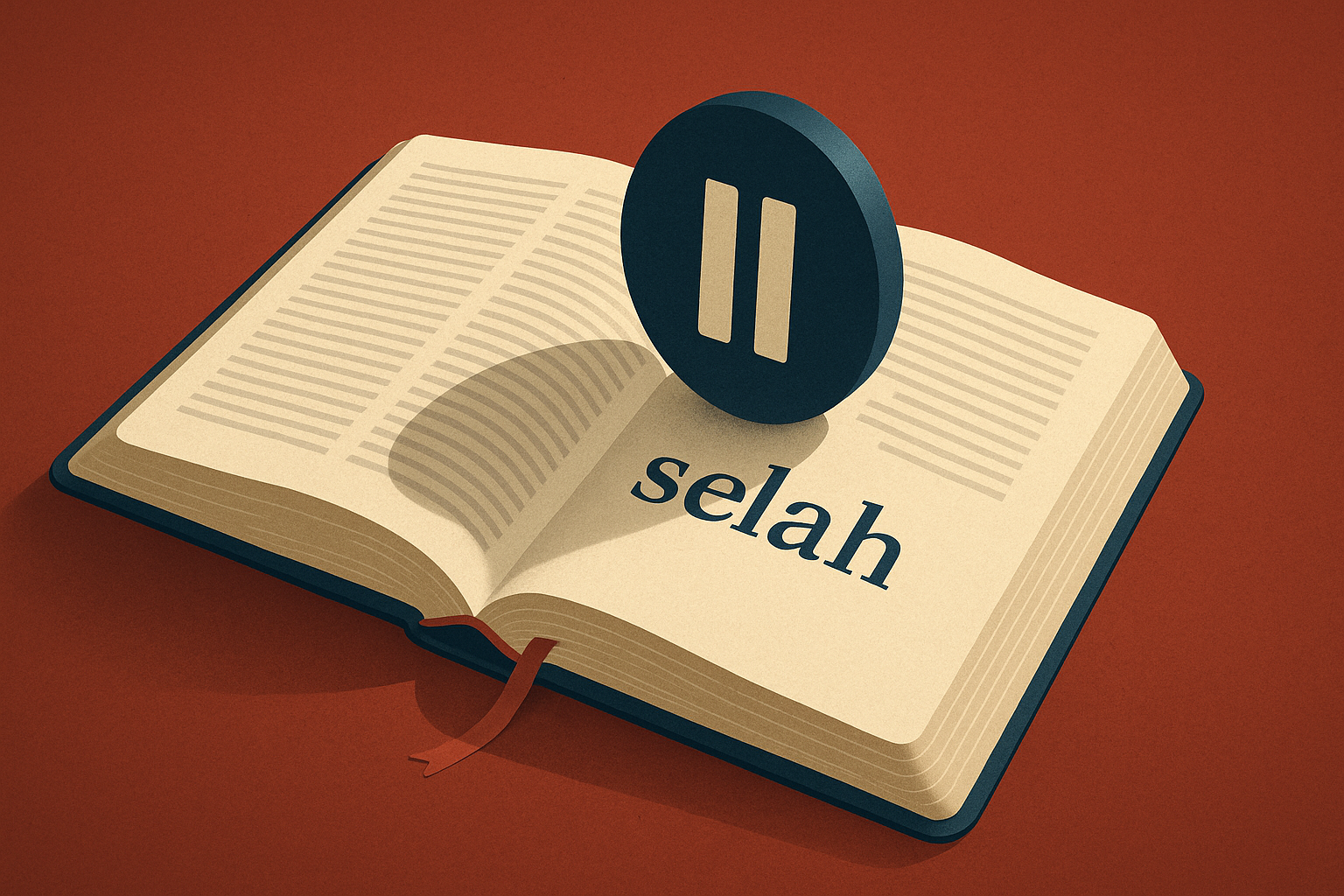
Selah is the most-skipped word in the Psalms. You read past it, your eyes barely register the four letters, and you keep going — which is exactly the opposite of what Selah is asking you to do. The word appears 74 times in Scripture and almost certainly functioned as a stage direction: stop, lift your voice, let the music swell, sit with what you just said.
Here is the honest part: nobody can prove what Selah meant to the original Hebrew choirmaster. The translators of the King James left it untranslated for a reason. But the uncertainty is not a dead end. It is a doorway. Once you know what Selah is doing in the text — even without knowing its precise dictionary entry — you can read a psalm with the rhythm its author built into it.
This piece gives you the short answer, the scholarly disagreement worth knowing about, and the specific interpretive moves Selah invites the next time you sit down with Psalm 3 or Habakkuk 3. If you want to check the Hebrew on every occurrence yourself, the Selah Bible reader has Strong's interlinear on every word.
Key Takeaways
- Selah appears 74 times in Scripture — 71 in the Psalms and 3 in Habakkuk 3 — and almost certainly functioned as a musical or liturgical cue rather than a word with semantic content.
- The strongest translations cluster around three meanings: pause, lift up, and interlude — and reputable Hebrew lexicons admit the evidence for any single choice is thin.
- When you hit Selah, treat it as a stage direction: stop reading, re-read the preceding line, and ask what the psalmist wants you to sit with before moving on.
- Selah is not a name of God, not a command to worship, and not an Amen — those readings come from devotional tradition, not the Hebrew text.
- For sermon prep, mark every Selah in your passage first; the pattern often reveals the psalm's structural seams before any commentary does.
What Selah means — the short, honest answer
Selah (Hebrew סֶלָה, selāh) is a liturgical or musical notation embedded in the Hebrew text. The most defensible translations cluster around three options: pause, lift up, or interlude. Pick any reputable lexicon and you will find some combination of those three with a candid admission that the evidence is thin.
Two etymological roots do most of the work. The first is salal, meaning to lift up, raise, or exalt — which would make Selah a cue to raise the voice, raise the instruments, or raise the worshipper's heart. The second possibility ties Selah to the Aramaic root for bending or prostrating, or to a technical term for musical staging in the second temple. The Septuagint, working in the third or second century B.C., rendered Selah as diapsalma — literally a musical interlude between psalm sections. That is the earliest interpretive vote on record, and it lands squarely on the musical reading. You can see the lexical debate laid out at Bible Hub and a fuller history at Wikipedia.
Now the part most articles will not say plainly: no one knows for certain. Hebrew scholars have been arguing about Selah for over two thousand years, and the disagreement is itself a clue. Selah is so ancient that even the rabbis who preserved the text were already unsure of its exact technical sense. It belonged to a living worship tradition that left the page behind.
The practical upshot is the most important thing in this section. Selah is a stage direction, not part of the prayer. The psalmist is not saying Selah to God. The editor or worship leader inserted Selah to tell musicians and worshippers what to do at that exact moment — pause here, swell the strings here, lift the voices here. When you read a psalm aloud, you should not say the word Selah out loud any more than an actor would read the words stage left from a script.
Read Selah as a director's cue. Next time you read a Selah psalm, treat the word as a beat rest. Stop reading. Re-read the line that came right before it. Ask: what did the psalmist just claim, confess, or accuse? Selah is telling you that line was load-bearing.
Where Selah shows up: 71 times in Psalms, 3 in Habakkuk
The numbers are tight and worth memorizing: 71 occurrences in the Psalms, 3 in Habakkuk 3 — and nowhere else in the Hebrew Bible. That distribution is not random. Selah lives almost exclusively in material written for sung, corporate worship.
74total occurrences of Selah in the Hebrew Bible — 71 in Psalms and 3 in Habakkuk 3Masoretic Text
Look at who wrote the psalms where Selah clusters. They are attributed overwhelmingly to David, the Sons of Korah, and Asaph — the temple's musicians and worship leaders. These were the people responsible for what the congregation actually sang. If Selah were a theological term, you would expect it scattered through the prophets and the Torah. It is not. It is concentrated in the songbook of the second temple.
Habakkuk 3 is the case that closes the argument for most scholars. The chapter opens with a superscription: A prayer of Habakkuk the prophet, on Shigionoth — Shigionoth being a musical term. It ends with To the choirmaster: with stringed instruments. In between, Selah appears three times. Habakkuk lifted a prayer, set it to music, handed it to the worship director, and marked it for performance. That is the smoking gun. The piece reads as a psalm because functionally it is one. Logos has a useful breakdown of this pattern in its Selah word study.
Open Psalm 3 — the first Selah in Scripture — and watch what happens. David is fleeing Absalom. The opening lines are raw: Lord, how are they increased that trouble me! many are they that rise up against me. Many there be which say of my soul, There is no help for him in God. Then: Selah. The pause lands right after the accusation that God will not save. The music stops. The congregation breathes. And then verse 3 begins: But thou, O Lord, art a shield for me. The Selah is not decorative. It is the silence that lets the contradiction land.
This is the move Selah keeps making across the Psalter. It falls after a declaration of enemies (Psalm 3:2), after a question hurled at God (Psalm 4:2), after a confession of sin (Psalm 32:5), after a vow (Psalm 60:4). Selah marks the hinges of the psalm — the points where the prayer pivots and you, the reader, are supposed to feel the weight before the turn.
Don't read past it. The single most common mistake with Selah is treating it as a printing error. Most modern translations relegate it to small italics in the margin or a footnote, which trains your eye to skip it. If you are preaching from a Selah psalm, the structural breaks marked by Selah are often the natural outline of your sermon.
There is one more interpretive thread worth pulling. The Septuagint's diapsalma — interlude — suggests Selah marked a moment when instruments played without singing. If that is right, Selah is the ancient equivalent of a key change or an instrumental bridge: a deliberate musical and emotional gear shift built into the worship itself. Crosswalk and Bible With Life walk through the implications for how the psalms were actually performed.
How to read a psalm differently because Selah is there
Here is the practical move. When you hit Selah, do three things in order: stop, re-read, then read forward slowly. Stop because that is what the marker is asking for. Re-read the line above it because Selah almost always punctuates a load-bearing claim. Then read the next line slowly because Selah marks transitions — the psalm is about to turn, and the turn is the point.
Stop reading at the word Selah. Do not say it aloud.
Re-read the verse immediately before Selah. Ask: what claim, confession, or accusation just landed?
Read the line that follows slowly. Notice whether the psalmist shifts from complaint to trust, from question to answer, or from petition to praise.
Mark the Selahs in your Bible as section breaks. They often outline the psalm better than the chapter divisions printed by medieval editors.
If you are preparing a sermon, build your outline around the Selahs rather than against them.

Try this on Psalm 32. The Selahs fall after verse 4 (the misery of unconfessed sin), verse 5 (the moment of confession), and verse 7 (God as hiding place). Three Selahs, three movements: the weight of guilt, the relief of confession, the safety that follows. Read it that way and the psalm preaches itself.
If you want to study the Hebrew context on a specific occurrence, pull up the verse in an interlinear and look at what comes immediately before and after. The Strong's number for Selah is H5542. Every occurrence is tagged and searchable in the Selah interlinear reader, which lets you jump from any Psalm to the underlying Hebrew without leaving the page. You can scan all 74 occurrences in an afternoon and see the pattern for yourself.
Selah is the silence that lets the contradiction land.— On reading Psalm 3
Why the uncertainty is not a problem
Some readers get nervous when scholars admit they do not know exactly what a Hebrew word means. That nervousness is misplaced here. The uncertainty about Selah is not the kind that threatens doctrine — it is the kind that comes from a word being so old and so technical that its precise mechanics outlived its everyday use. We have the same problem with stage directions in Shakespeare and tempo markings in early medieval music.
The theological content of the Psalms does not hang on Selah. What hangs on Selah is how you read the Psalms — the rhythm, the breath, the structural awareness. And on that question, the three leading translations (pause, lift up, interlude) all push you in the same direction: slow down, attend, let the line you just read do its work before you move on.
The Psalms were sung by people who knew exactly what Selah meant because they heard the instruments swell when it appeared. We have lost the music. What we still have is the mark — a small, stubborn word that reminds us these prayers were never meant to be skimmed. Treat Selah as the psalmist's hand on your shoulder, slowing you down at the moment the prayer pivots. That is the reading the text was built for, and it is the one most modern readers never get because they read past the word that was put there to stop them.
Frequently asked questions
What does Selah mean in the Bible?
Selah is a Hebrew term — סֶלָה — that appears as a notation inside poetic texts, most often in the Psalms. The best-supported meanings are pause, lift up (the voice or instruments), or musical interlude. It is a direction to the reader or worshiper, not a word with theological content of its own.
Why does Selah appear so often in the Psalms?
The Psalms were Israel's hymnbook, sung in temple worship with instruments and choirs. Selah likely marked moments for the music to swell, the singers to pause, or the congregation to reflect — the same way modern sheet music uses rit. or a fermata. That is why 71 of the 74 occurrences sit inside the Psalter.
Is Selah a name of God or a command to worship?
No. Some popular devotional writing treats Selah as a synonym for praise Him or even a divine name, but no Hebrew lexicon or serious commentary supports that. The root meanings point to lifting up the voice or pausing — actions in worship, not the object of worship.
What does Selah mean in Hebrew literally?
The two main proposed roots are salal (to lift up, raise) and salah (to pause or measure). Neither is certain, which is why translators from the KJV onward typically leave it transliterated rather than rendered. You can check every occurrence with Strong's interlinear on the Selah Bible reader.
Should I say 'Selah' out loud when reading the Psalms?
You can, but the more useful practice is to do what Selah asks: stop, breathe, and re-read the line before it. If you are reading aloud in a group, a deliberate pause communicates the function better than pronouncing the word. Treat it as a rest, not a syllable.
Does Selah appear anywhere outside the Psalms?
Yes — three times in Habakkuk chapter 3, which is itself a psalm-like prayer set to the chief musician on my stringed instruments. That distribution is one of the strongest clues that Selah is a musical notation: it shows up exactly where you would expect performance directions, and nowhere else.
Study every Selah in contextRead all 74 occurrences with Strong's Hebrew interlinear, classic commentary from Spurgeon, Wesley, and Clarke, and clean typography built for sustained reading — all free on Selah. Open the Bible reader →
Comments
Be the first to comment.